
Where to Stay in Lofoten: Best Areas, Islands & Villages for Every Kind of Trip
The islands look small on a map. The right base still changes the whole trip.

Our view from our rorbu at Retro Rostad Rorbuer (got an awesome deal in October)
Lofoten isn't one destination; it's a chain of islands strung together by bridges and a single road. And where you sleep decides how much of it you see, especially if you have a short amount of time. Base yourself wrong and you'll spend half your trip driving back and forth for dinner. Base yourself right, and everything from the Reinebringen sunrise to the last ferry out is fifteen minutes away. This is a village-by-village breakdown of where to stay in Lofoten, built around what each area is good for.
For the full list of specific hotels and resorts across the islands, our Best Hotels & Resorts in Lofoten guide has the complete picks; this one is about choosing the right base first. We stayed at a few!
🛌 Where to stay:
• Rostad Retro Rorbuer, Reine — we stayed here on a last-minute deal and it turned out to be one of the best views we've ever had.
• Skarungen, Kabelvåg — we stayed here and it's one of Lofoten's best wellness stays.
• Kaikanten Rorbuer, Sennesvik — we stayed here in October and got a northern lights show right by the pier. Great value.
• Eliassen Rorbuer, Hamnøy — the red cabins from every Lofoten photo you've ever seen.
🇳🇴 Top experiences:
• Midnight sun kayak — paddle past rorbuer and mountain peaks straight into the fjord.
• Northern lights tour from Henningsvær — small group (max 7), guided by a local who tracks the forecast in real time.
• Snowshoe hike — Enjoy the still, frozen beauty of Lofoten without the crowds
🚗 You need a car in Lofoten. The islands stretch 170km and public transport isn't great. Book your rental in Bodø before you cross — significantly cheaper than picking one up on the islands.
Jump to: Svolvær · Kabelvåg · Henningsvær · Leknes and Ballstad · Haukland, Uttakleiv, Unstad, Ramberg and Kvalvika · Reine, Hamnøy and Sakrisøy · Nusfjord and Å · FAQ
Where to stay in Lofoten and best base: quick answer
Staying in or near Svolvær gives you the easiest logistics: the main airport, ferry connections, and the most restaurants and services. Staying around Reine, Hamnøy, or Sakrisøy puts you closest to the scenery everyone comes for and to the Moskenes ferry, but it's the farthest from the airport. Leknes and Ballstad split the difference, a properly central base with its own small airport, good if you don't want to commit to one end of the islands. Henningsvær, Nusfjord, and Å are each worth a night or two on their own merits rather than as a full-trip base.
Solvær
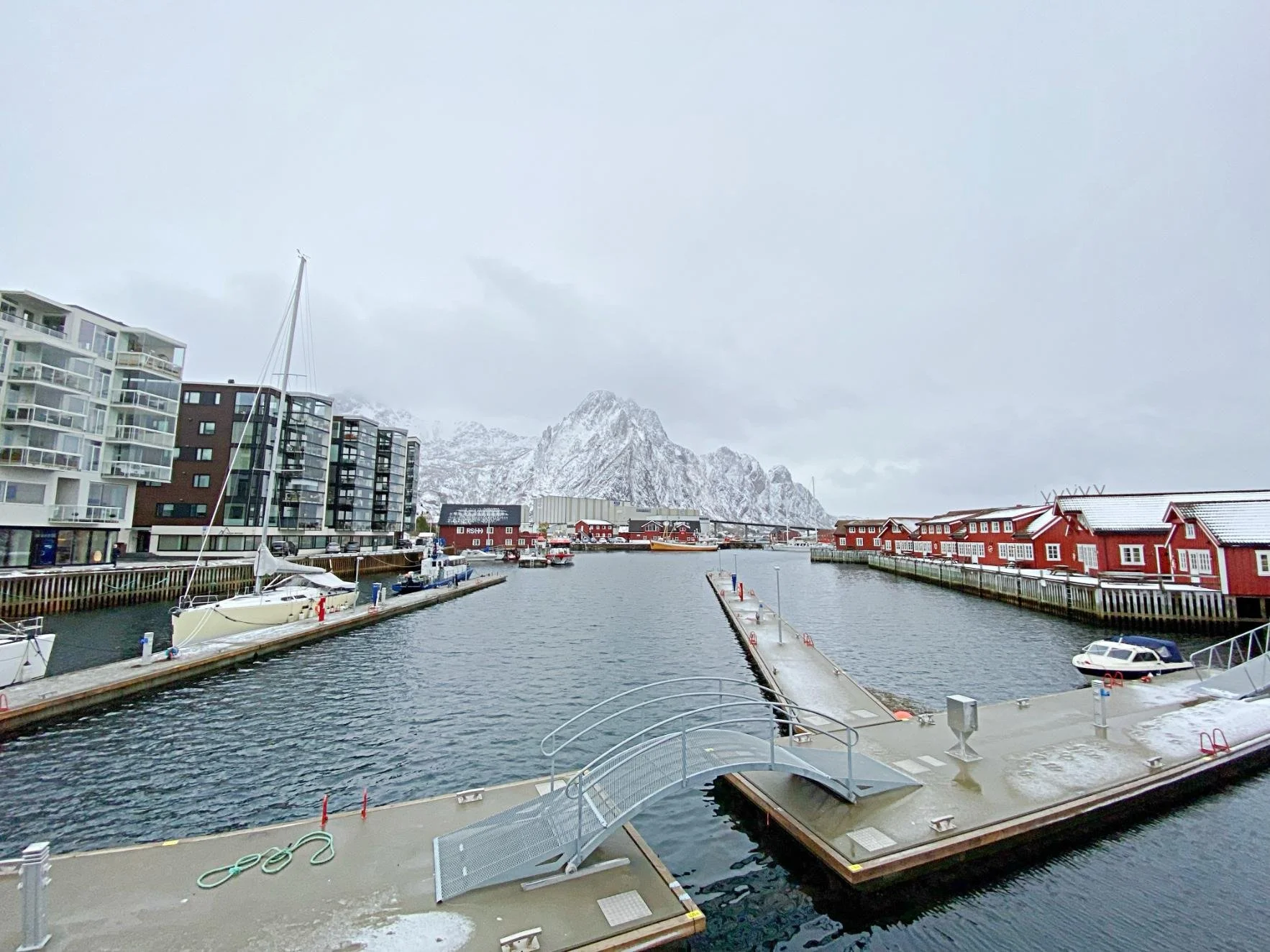
Svolvær in October
Distance: the region's main hub, about 6 km from Svolvær Airport.
Svolvær is Lofoten's largest town and the easiest place to land if you're flying in. Svolvær Airport has Widerøe flights to Bodø year-round plus seasonal summer routes, and the town itself has the most restaurants, shops, and boat trips of anywhere on the islands. If this is your first or last night in Lofoten, or you don't want to think about logistics, Svolvær handles that.
It's also the least scenic of the bases on this list, more working town than postcard village. That being said, it’s a really pretty city, but standards are high on Lofoten! Our full hotel and room guide has specific picks in town, including Scandic Svolvær and Thon Hotel Svolvær. If you want a quieter option nearby without giving up the easy airport access, Lofoten Links Lodges on neighboring Gimsøya, home to the golf course, is a calmer alternative a short drive out.
For more options, read our guide to the best Hotels in Svolvær and Around.
Kabelvåg

Enjoying Skårungen sauna, hot tub, and cold plunge of course!
Distance: about 6 km, roughly 7 minutes from Svolvær.
Kabelvåg is what people mean when they say "stay near Svolvær but not in it." It has its own history as a medieval trading post for the stockfish trade, plus the Lofoten Aquarium and the striking wooden Vågan Church, all while being close enough to Svolvær's airport and restaurants that you're not sacrificing convenience.
We'd highly recommend Skarungen, which adds a sauna, restaurant, and outdoor hot tub to the deal, a good way to end a day of driving the islands. We stayed there a few years ago and tried their sauna and hot tub more recently.
Henningsvær
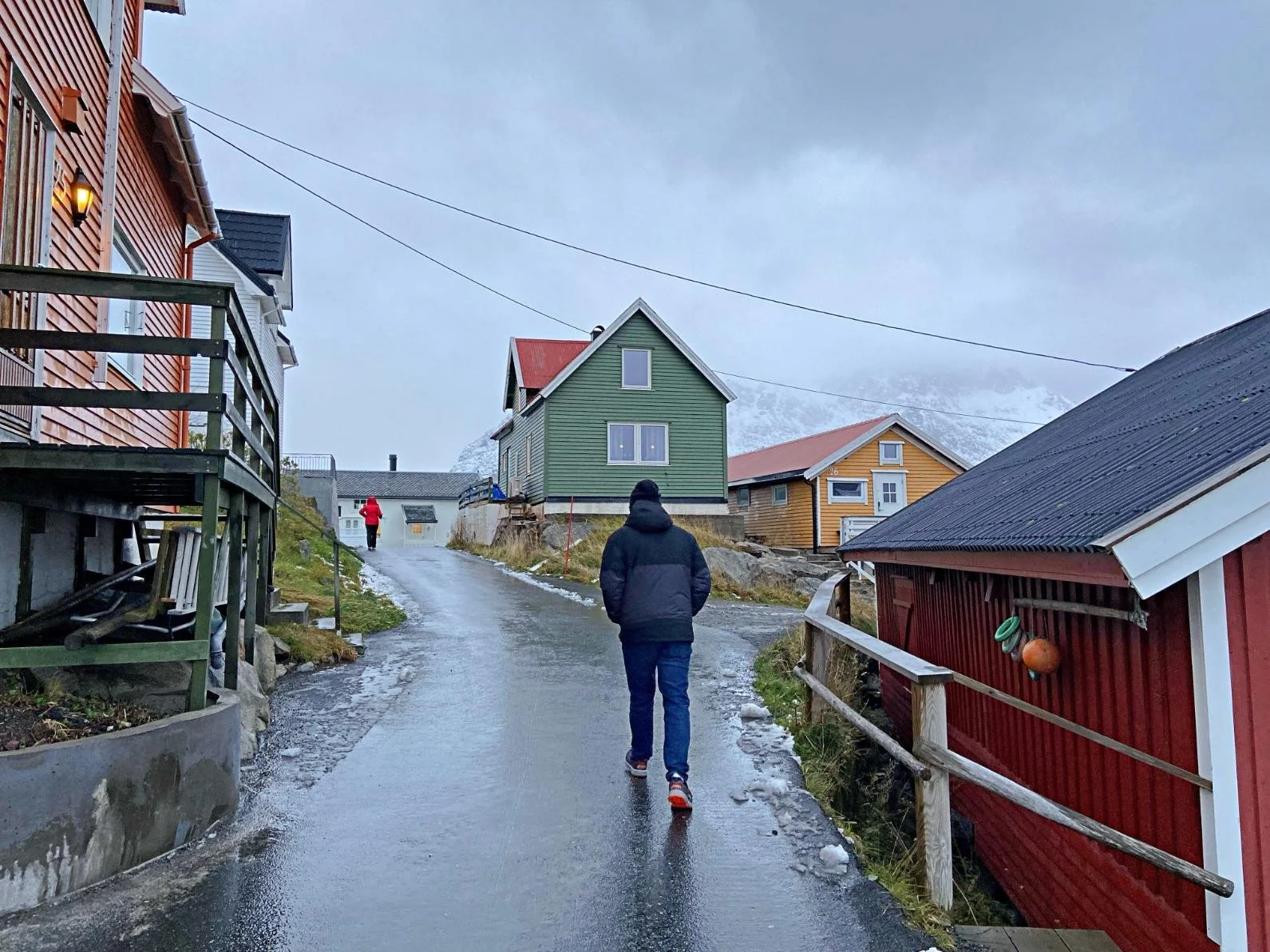
Exploring picturesque Henninsgvær (our favorite restaurant Fiskekrogen is there)
Distance: about 26 minutes from Svolvær, a detour off the main road.
Henningsvær gets called the Venice of Lofoten (ok, maybe minus the temperature), spread across a cluster of small islets with a working fishing harbor, art galleries, and a football pitch famously wedged onto the rocks between the water. It's less a logistics base than a destination in itself, and staying a night here instead of just visiting on a day trip means you get the village without the tour buses. We love it at dusk!
It's also where the northern lights tour from Henningsvær departs from, a small-group hunt guided by someone tracking the forecast locally. For hotel picks in the village itself, see the full guide.
Leknes and Ballstad

Enjoying the view at Kaikanten Rorbuer!
Distance: central Lofoten, with Leknes Airport about 2 km from town.
Leknes is the practical middle ground. It has its own small airport with the same Widerøe connections as Svolvær, it sits roughly equidistant from the eastern islands and the Reine cluster to the west, and it's close to Haukland and Uttakleiv, two of Lofoten's best beaches amazing spots for northern lights too). Ballstad, just south, is a working fishing village with a similar central position and a bit more character than Leknes itself.
If you're not committing to a single end of the islands, or you want a base for beach days as much as village-hopping, this is it. Nearby in Sennesvik, Kaikanten Rorbuer is a solid value pick with open water views and none of the crowds (or high prices) you'd find further into Reine. We found it to be an amazing value in October, with a strategic location close to Stamsund ferry terminal (Hurtigruten).
Haukland, Uttakleiv, Unstad, Ramberg and Kvalvika
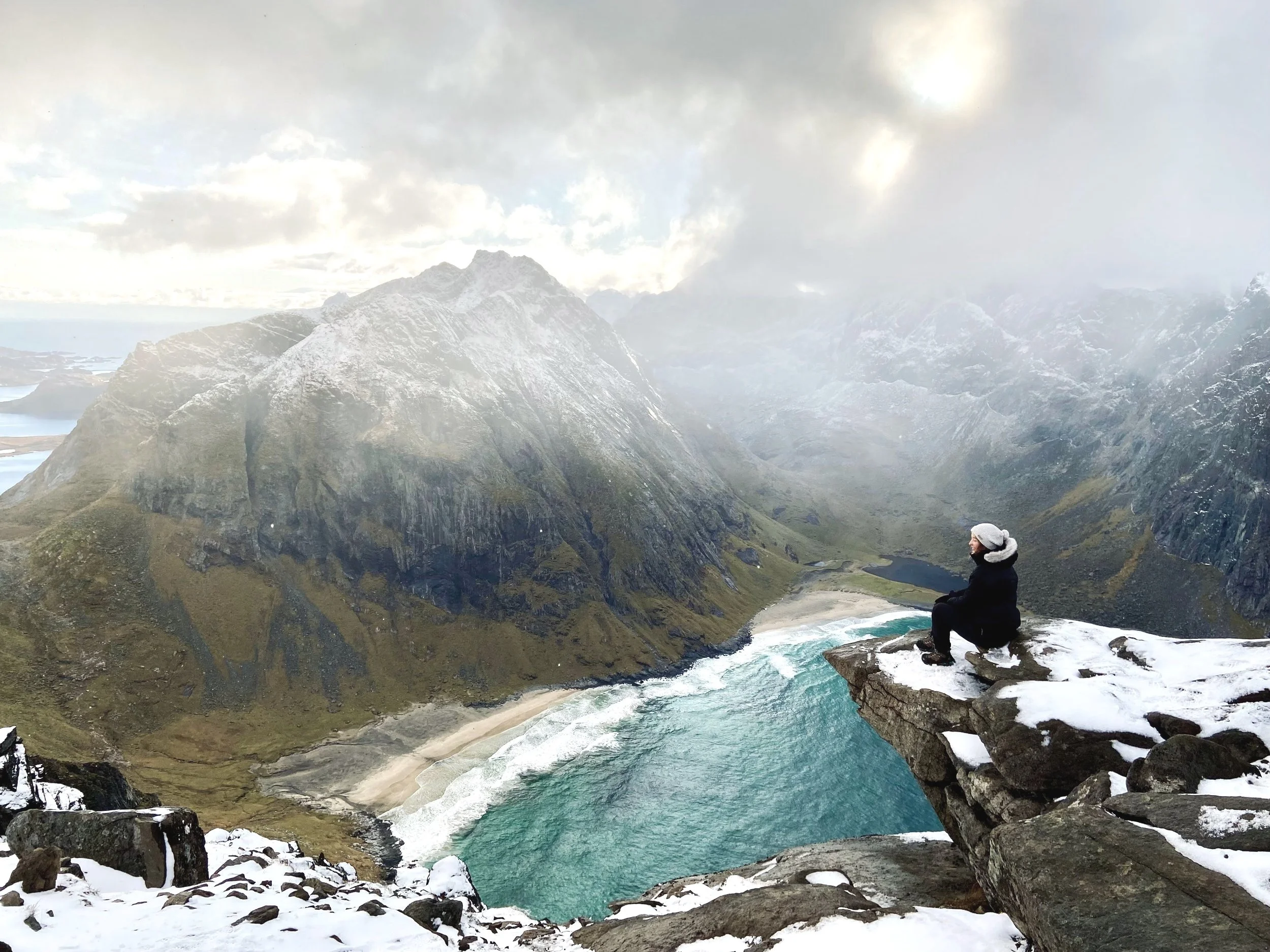
We hiked Ryten (above Kvalvika Beach) in summer and fall, and it never disappoints
Distance: Haukland about 10 km and Uttakleiv about 12 km north of Leknes; Unstad about 23 minutes' drive from Leknes; Ramberg about 30 km west of Leknes; Kvalvika reachable only on foot, via Fredvang.
Haukland and Uttakleiv
If the beaches are why you're making this trip, this is the stretch. Haukland and Uttakleiv sit right next to each other on Vestvågøy, connected by a short walking path over the headland between them, both drive-to white sand with mountains dropping straight into the water. Neither has much accommodation directly on the sand, so most people base in Leknes and drive out for the day.
Unstad
Unstad, a bit further along the same coast, is Lofoten's surf beach (read our article Things to Do in Lofoten for more), a small settlement of under 20 year-round residents built almost entirely around the waves. Near Unstad Arctic Surf lovely café (we loved the yummy hot chocolate after a day in the cold), you’ll find the awesome Unstad Arctic Resort and Unstad Surfpacker Hotel for lower budgets.
Ramberg
Ramberg, further south on Flakstadøya, is a different kind of stop: it's Flakstad's municipal center, with a gas station, shop, restaurant, and its own wide crescent of white sand right in the village, so it works as a base rather than just a beach visit. Ramberg Resort sits right on that beach with cabins, apartments, and a restaurant.
Fredvang (Kvalvika)
Kvalvika is the outlier: no road reaches it. You hike in, usually from a car park near Fredvang, roughly 40 minutes to an hour each way, or continue up to the Ryten viewpoint above it for the classic look down onto the beach. There's no accommodation at Kvalvika itself, but Fredvang, the small village at the trailhead, does have one: Lydersen Rorbuer, a budget hostel and apartment setup right on the water, and a practical base if you want to be first on the trail.
A note on camping
Norway's right-to-roam lets you pitch a tent on uncultivated land generally, but Lofoten has its own added restrictions given how much traffic these beaches see: camp at least 150 meters from the nearest house or cabin, move on after two nights in one spot, and stay off cultivated farmland entirely. Haukland Beach itself is on the list of spots where camping is now banned outright, along with Reinebringen, Reinefjorden's surroundings, and the end of the road in Å, so check current signage before you pitch anywhere that popular. Camper vans face the same rules and can't drive off designated roads onto open land. If you want the sure thing, Ramberg Resort and Unstad Arctic Surf both run proper campsites alongside their rooms.
Reine, Hamnøy and Sakrisøy
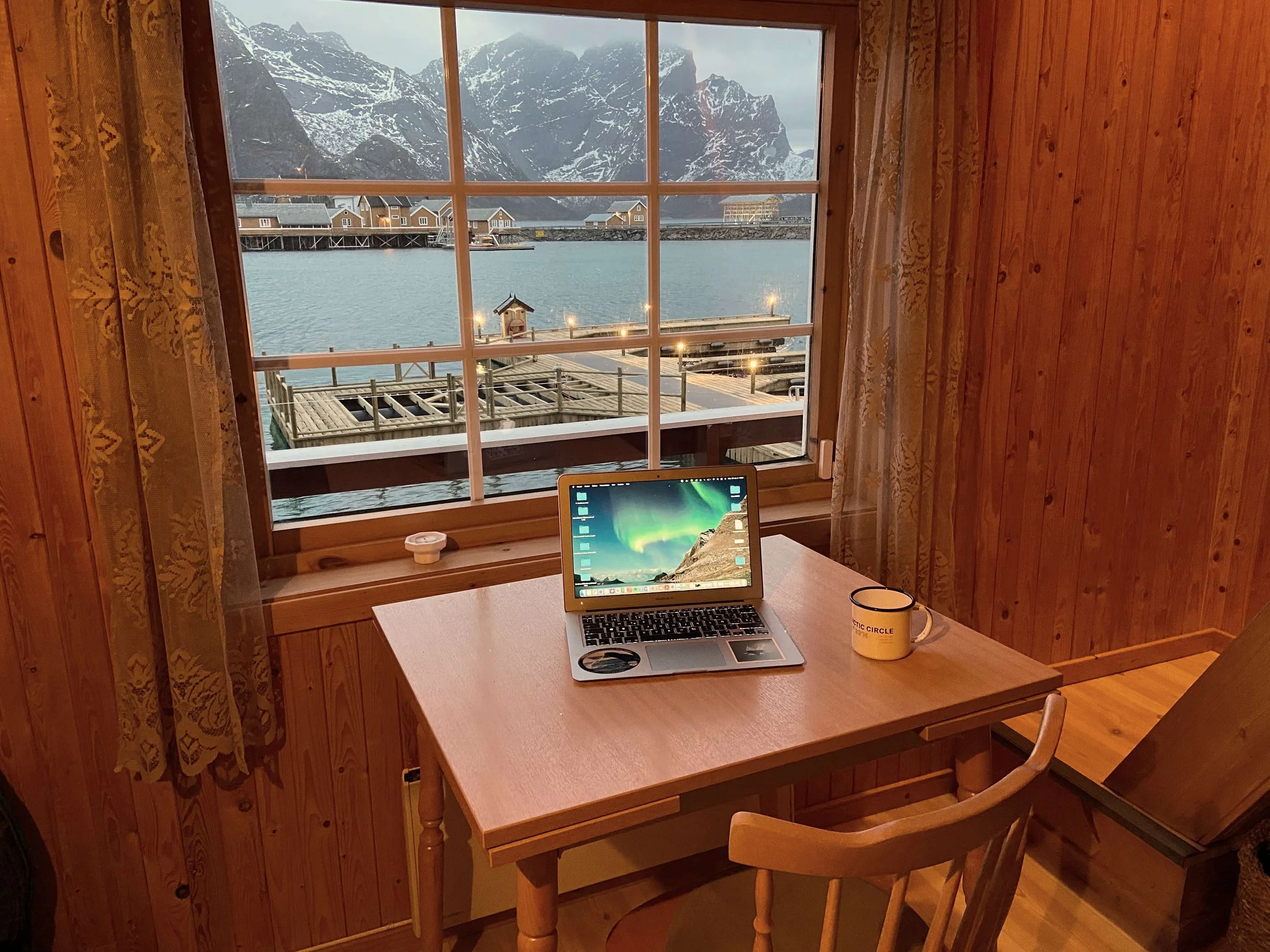
Hard to work at Rostad Retro Rorbuer!
Distance: the far southwest, about 5 km from the Moskenes ferry terminal to Reine, 9 km to Hamnøy.
This cluster is the Lofoten of every photo you've seen: sheer peaks dropping straight into the fjord, red rorbuer on stilts over the water, and the Reinebringen hike for the view looking back down on all of it. It's also the closest base to the Moskenes ferry to Bodø, which matters if you're arriving or leaving that way rather than by air. Read our guide to Renting a Car in Bodø if that’s the case.
The tradeoff is distance from the airports. Expect over an hour from Leknes and more from Svolvær, and this is the most visited part of the islands, so book well ahead for summer. We've pulled real picks from across the cluster: Eliassen Rorbuer in Hamnøy for the classic red-cabin experience, Rostad Retro Rorbuer in Reine itself (we absolutely loved it), and Reinefjorden Sjøhus if you want a proper fisherman's house rather than a rebuilt cabin. Sakrisøy, between Reine and Hamnøy, is smaller and quieter than either.
You’ll find more details and options in our selection of the Best Reine Rorbuer.
Nusfjord and Å
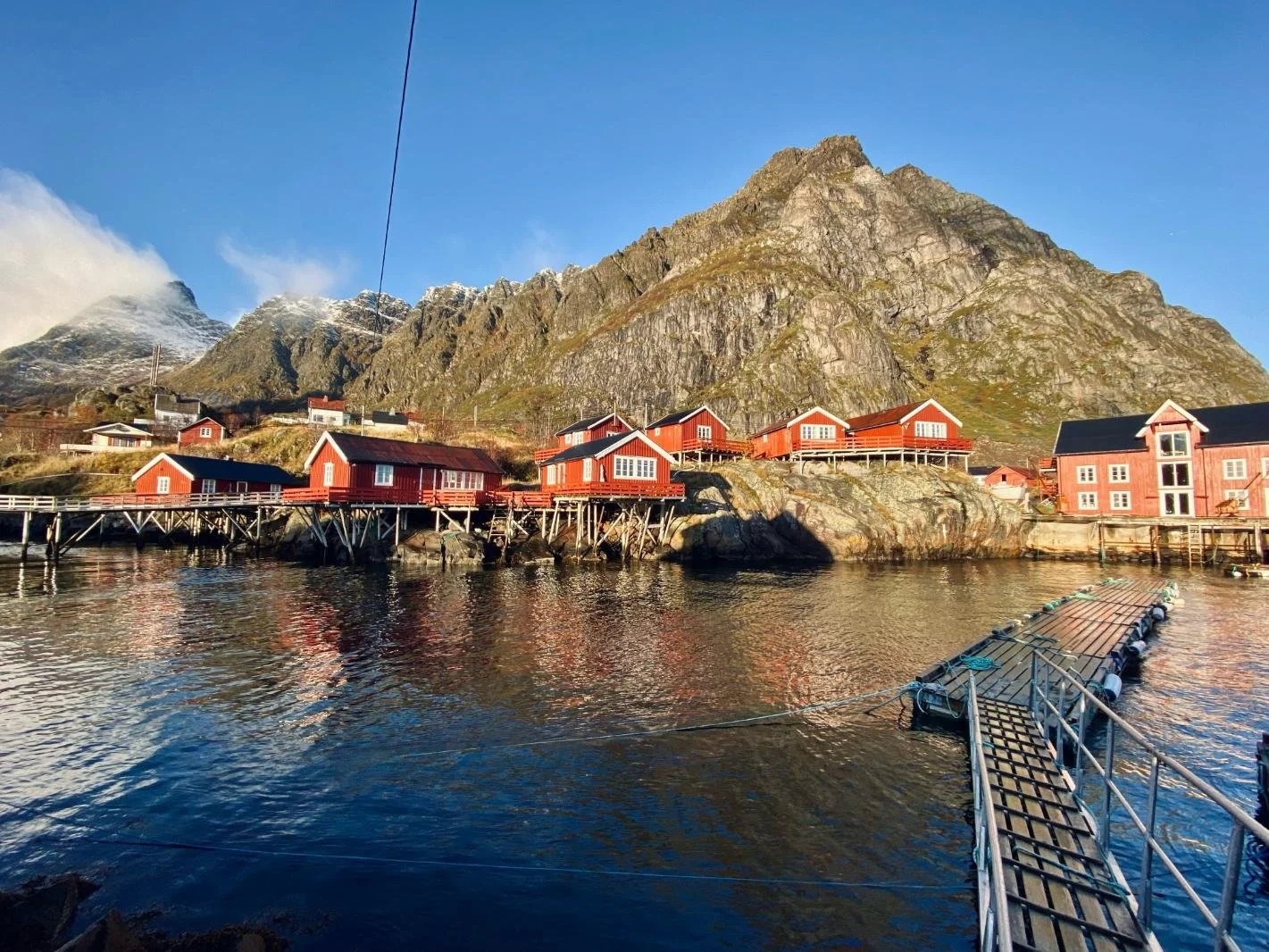
Å i Lofoten on a sunny day, yeah!
Distance: the end of the road, past Reine, and not a base for your whole trip.
Nusfjord is a preserved 19th-century fishing village, small enough to walk in ten minutes, and Å, whose name is the last letter of the Norwegian alphabet, is where the road physically ends, home to the Norwegian Fishing Village Museum and a handful of original buildings. Both are worth a night for the atmosphere and the sense of having reached the edge of something, but neither has the restaurant or activity options to comfortably anchor a longer stay. And it gets really, really crowded during the day, especially in summer.. Treat them as a stop, not a base, and check our full hotel guide for what's currently bookable in each.
Explore more rorbuer and hotels in the Lofoten Islands
Zoom in below to explore the dreamiest rorbuer and hotels in the Lofoten. All locations update live with real prices and availability.
✈️ Find flights
🏨 Explore hotels, apartments, guesthouses, cabins
🧭 Browse activities and tours
🚗 Compare car rentals
🧳 Get travel gear
🛡️ Travel safe with Heymondo Travel Insurance (5–15% off)
📱 Get a travel eSIM
🐾 Protect & track Arctic wildlife with Fahlo Bracelets (20% off)
FAQ: Where to stay in Lofoten
What's the best area to stay in Lofoten? It depends on the trip. Svolvær or Kabelvåg for easy airport access and services, Reine or Hamnøy for the classic scenery and hiking, Leknes if you want one central base for both.
Do I need to stay in more than one place? Not required, but splitting a week between an eastern base like Svolvær or Kabelvåg and a western one like Reine or Hamnøy cuts down on backtracking, since the islands run in a long line rather than a loop.
Which area is closest to the airport? Svolvær and Leknes both have their own small airports. Svolvær Airport is about 6 km from town, Leknes Airport about 2 km.
Which area is closest to the Bodø ferry? Reine, about 5 km from the Moskenes ferry terminal, and Hamnøy, about 9 km.
Is Henningsvær worth staying in overnight, or just visiting? Either works, but staying a night lets you see the village without the day-trip crowds, especially in the evening and early morning.
Should I rent a car for getting between areas? Yes. Public bus service exists but is limited, and most of what makes Lofoten worth visiting is spread out along the E10. Read our guide to Renting a Car in Lofoten).
Where should I stay for the best beaches? Ramberg, if you want to sleep near one. Haukland and Uttakleiv are better beaches but have little accommodation of their own, so most people base in Leknes, about 10 to 12 km away, and drive out. Surfers should look at Unstad instead, which has its own dedicated surf lodge.
Can you camp in Lofoten? Yes, under Norway's right-to-roam, but with real limits: 150 meters from any house, no more than two nights in one spot, and no camping on farmland. Haukland Beach specifically has camping banned outright, along with a handful of other overused spots, so check current signage rather than assuming a beach is open.
Pick Svolvær or Kabelvåg for logistics, Reine or Hamnøy for the scenery you came for, and Leknes if you can't decide. Lofoten rewards splitting your trip across two bases, especially once you factor in how much of the E10 you'd otherwise be driving twice. In Lofoten during aurora season? Check our favorite Northern Lights Hotels in Lofoten! And if you’re looking for activities, explore our favorite things to do in Lofoten.
Finally, explore all our Norway Travel Guides here.

Free download
Travel Cheaper Cheat Sheet
27 tips on flights, hotels, hidden costs and more — spend less without missing what actually matters.
No spam. Unsubscribe anytime.
Where to stay
Lofoten Hotels & Rorbuer
Where to Stay in Lofoten by Area
Best Northern Lights Hotels in Lofoten
Best Reine Rorbuer
Best Hotels in Svolvær
Things to do and when to go
Things to Do in Lofoten
Lofoten Hiking Guide
Best Time to Visit Lofoten
Northern Lights in Lofoten
Lofoten in Winter
Getting there and around
How to Get to Lofoten
Tromsø to Lofoten Road Trip
Renting a Car in Lofoten
