
Northern Lights in Sweden: Where to Go and When to See Them
Kiruna, Abisko, or Luleå: the fast version of everything you need to know before you go.

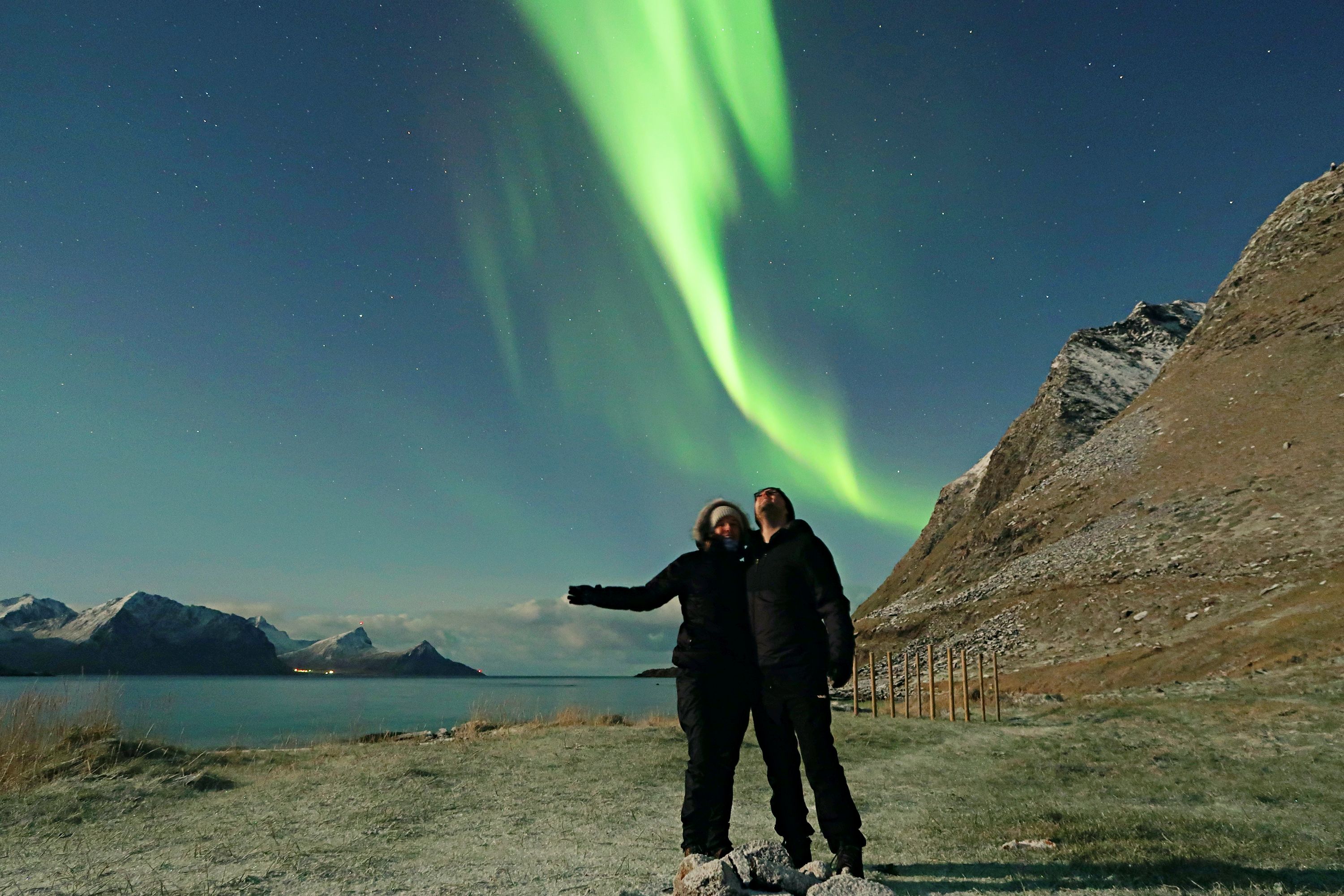
Trying to stay still for the photo at -20ºC is not as easy as you’d think….
Sweden doesn't have one northern lights destination, it has three, and they don't behave the same way. Kiruna, Abisko, and Luleå, all in Lapland, each give you a real shot at the aurora, but for different reasons, and the right base depends on the kind of trip you're planning. This page is the fast version: where to go, when to go, what your odds really are, and whether you need a tour at all, based on two decades of experience chasing the aurora in the far north.
Want to optimize your chances? See our Best Hotels to See the Northern Lights in Sweden.
🛌 Where to stay:
• Camp Alta, Kiruna: frozen lake, sauna, built for aurora watching.
• STF Abisko Turiststation: the hub for aurora travelers, right by the Blue Hole.
• Clarion Hotel Sense, Luleå: harbor views, the most central option in town.
🇸🇪 Top tours:
• Aurora Chase in Abisko: small group, local guide, built around the Blue Hole.
• Evening tour from Kiruna to Abisko: for when Kiruna's own sky clouds over.
• Sami culture, reindeer & northern lights, Luleå: meet a Sami family, feed reindeer, chase the aurora.
🚗 Tours include pick-up, but you can rent a car to chase clear sky on your own schedule. Book one here.
How to see the northern lights in Sweden: quick answer
Best aurora base overall: Kiruna. The widest range of tours, an airport, and the ICEHOTEL twenty minutes away.
Best for clear skies: Abisko, thanks to its "Blue Hole," a pocket of unusually stable, dry air created by the surrounding mountains.
Best for a quieter, more affordable base: Luleå, further south on the coast, and less built around tourism.
Best time to go: Late August through early April. December to March gives you the longest, darkest nights and generally the most stable weather.
Do you need a tour? No, not strictly. But one helps if you don't have a car, only have a night or two, if you’re a beginner at aurora chasing (read our guide: Northern Lights for Dummies) or if you’d rather have someone else tracking the sky while you focus on it.
Where to see the northern lights in Sweden

In February in Luleå, we got three awesome aurora nights in one week!
Kiruna
Kiruna is Sweden's northernmost town, sitting at roughly 67.85°N, about 145 kilometers north of the Arctic Circle and well inside the auroral oval, the band of sky around the North Pole where the aurora shows up most often. It's home to the Swedish Institute of Space Physics, which studies the aurora and publishes a free IRF Aurora Alert app for exactly this reason. You don't need to leave town to get a real shot at it, though the edges (Camp Alta, the hill behind Camp Ripan, any frozen lake) beat downtown's light pollution. Full breakdown in our Northern Lights in Kiruna guide.
Abisko
This stunning national park is about 1.5 hours from Kiruna and has the strongest reputation of the three, largely because of the Blue Hole, a recurring patch of clear sky created by the surrounding mountains and a fairly consistent wind pattern. Locals in Kiruna drive here themselves when their own sky clouds over. And we even heard of guides driving all the way from Rovaniemi when Finland is in the clouds! It's smaller and quieter than Kiruna, with less to do if the aurora doesn't cooperate but fantastic outdoor activities (it’s our favorite place for dogsledding). Full breakdown in our Abisko Northern Lights Tours guide and access options in our guide: How to Get to Abisko from Kiruna.
Luleå
This quaint city sits further south, on the coast, and trades some of the drama for convenience: less touristy, generally more affordable, and close enough to the city center that you don't always need to leave it. Plus, where else can you walk on a frozen archipelago and actually watch the aurora from there! We stayed under a week there one February and saw the aurora three nights running, which won't happen on every trip, obviously, but we’ll keep our fingers crossed for you. Full breakdown in our Luleå Northern Lights guide.
For the best places to stay, read our guide to theBest Hotels to See the Northern Lights in Sweden.
Or zoom in the maps below to explore hotels & cabins with aurora views in Swedish Lapland
Best time to see the northern lights in Sweden
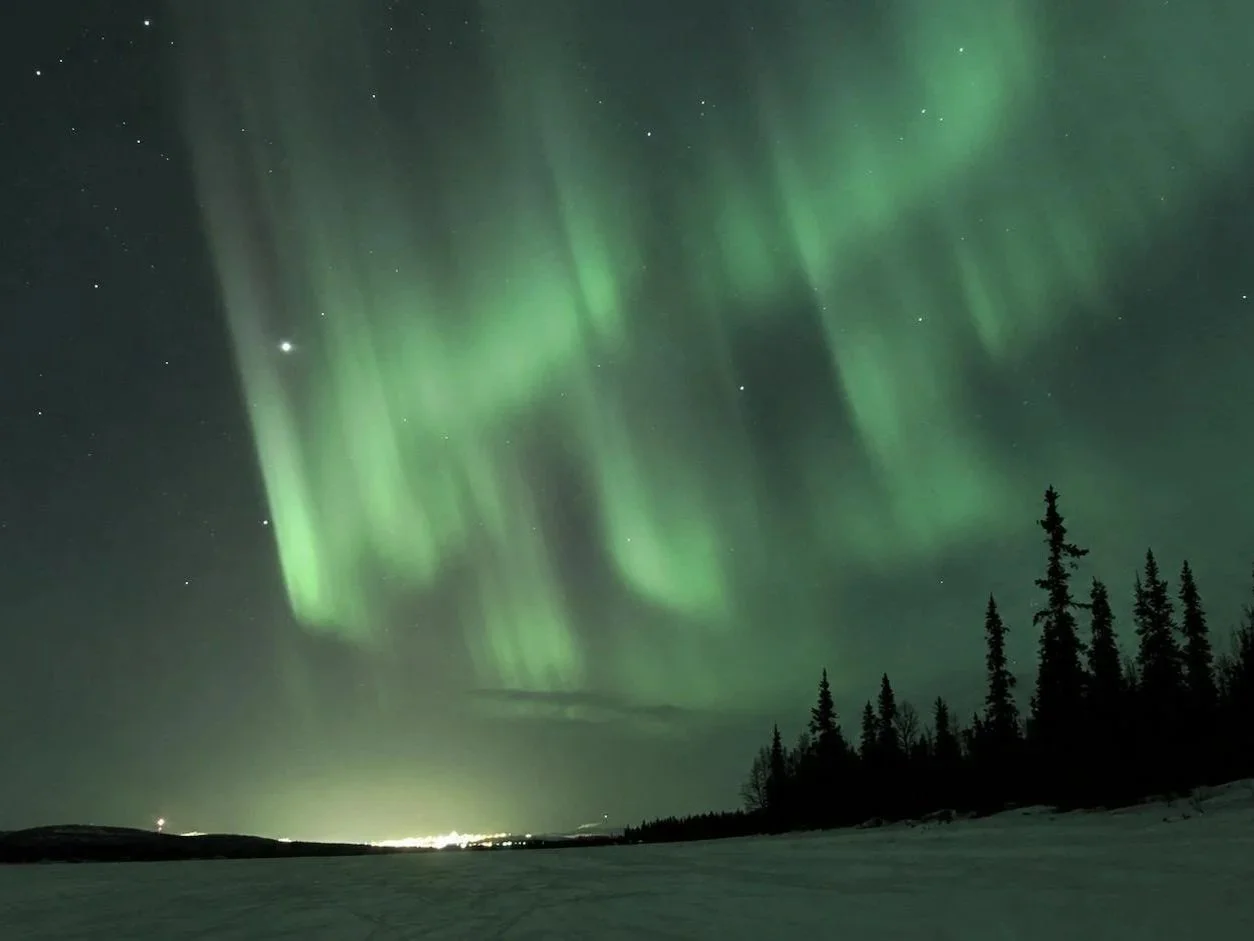
I took this photo in March from Camp Alta in Kiruna.
The season runs late August through early April, with December to March giving you the longest nights and, generally, the most stable weather.
A few things worth knowing before you pick your dates:
Darkness matters more than the calendar. Northern Sweden gets true polar night in December and January, meaning very little or no daylight. More darkness means more windows for a display.
Aurora activity tends to cluster around local magnetic midnight, roughly 10 PM to 2 AM, though this is a general pattern, not a fixed schedule, and displays can happen outside that window. We saw northern lights at 5pm!
Cloud cover matters more than the date you pick. A clear night with modest solar activity is still better than a stormy night with a strong forecast almost every time.
For the season-by-season breakdown across both Swedish and Finnish Lapland, see our Northern Lights in Lapland guide.
How to check the northern lights forecast in Sweden
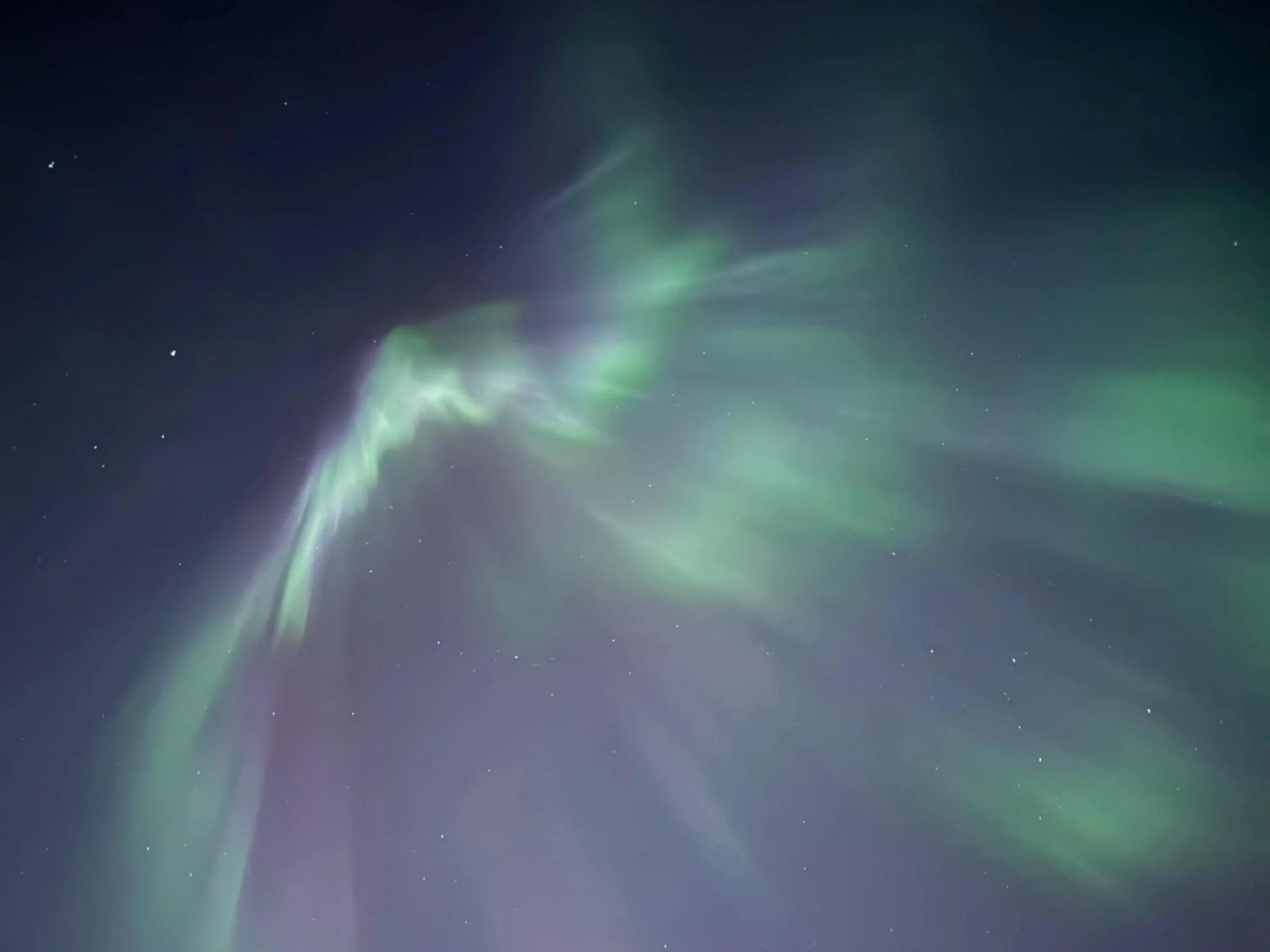
For an overhead display, you usually need a higher KP, but places like Abisko are “high” enough so a KP2 might suffice… On this photo, it was KP4 though.
Two things need to line up: solar activity, usually tracked with the KP index, and clear skies over wherever you're standing. Neither one alone tells the full story. A strong KP forecast under total cloud cover gets you nothing, and a modest KP number under a genuinely clear sky can still produce a real show. You can learn more in our article: Simple science behind the northern lights.
The Swedish Institute of Space Physics, headquartered in Kiruna, publishes a free IRF Aurora Alert app that sends a notification when conditions look favorable near town. Beyond that, pair any KP-index tracker with a straightforward local cloud cover forecast for your exact night, rather than relying on a single all-in-one score. Aurora forecasting is short-range by nature, usually just a few hours (sometimes minutes, trust us!) to a couple of days out, so don't plan an entire trip around a long-range prediction.
We don't have a verified source for a specific "percent chance of aurora" figure for Sweden as a whole, and we'd be skeptical of any tracker or app that quotes one with confidence.
Do you need a tour, or can you see the northern lights on your own?
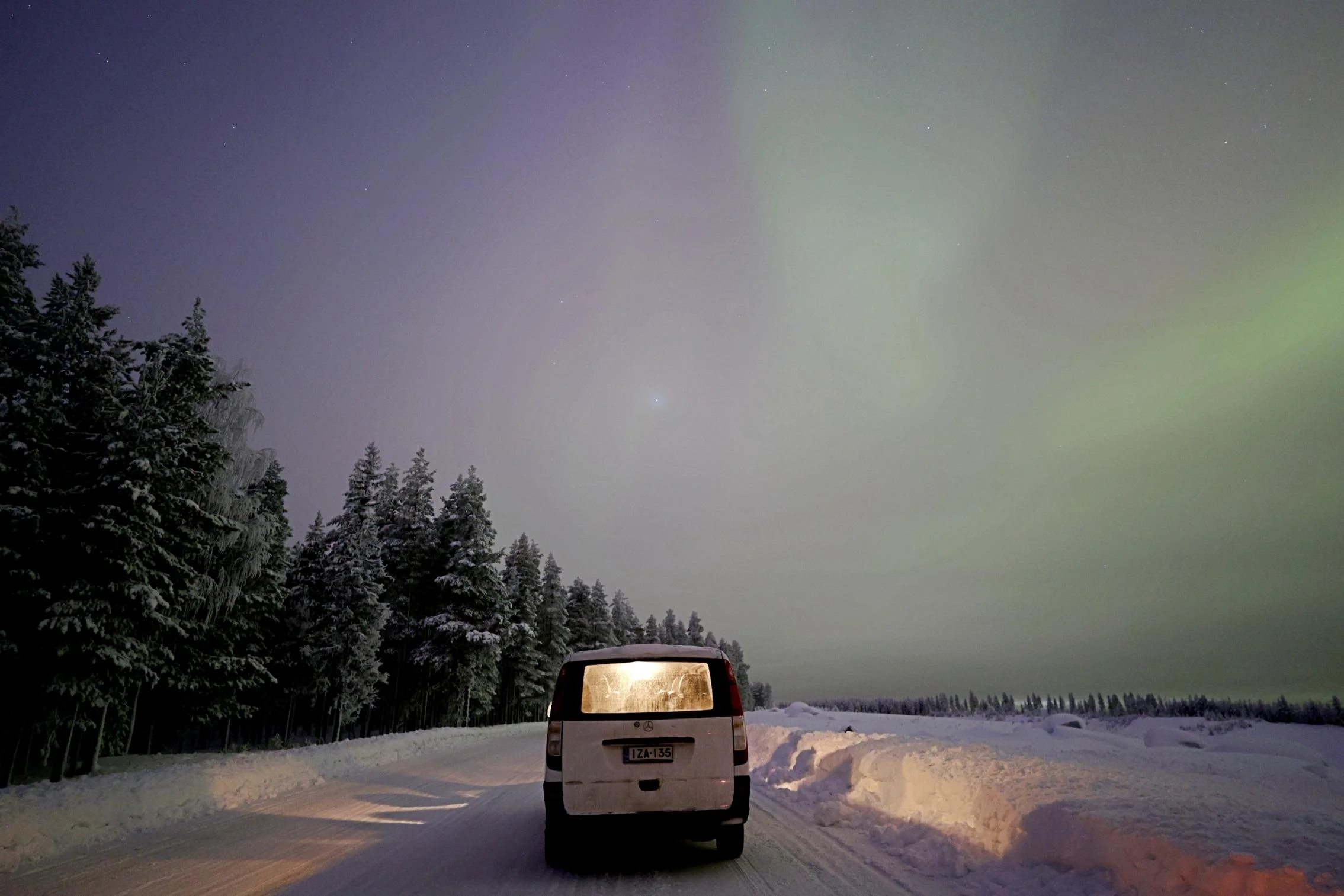
A van tour is a good idea if you want to warm up for a while!
You don't strictly need one. If you have a rental car and a few nights to spare, the edges of Kiruna, the area around Abisko, or a dark stretch of coast near Luleå are all accessible without a guide. Read our guide to Renting a Car in Kiruna if you want to go that route (pun intended).
A tour is worth it if you're short on time, don't want to drive in Arctic winter conditions, are a beginner at northern lights hunting, or would rather have someone tracking cloud cover in real time and moving you toward clear sky while you focus on the sky instead of the road. It's also the easier option if you're combining the aurora with something else, like dog sledding or a Sámi cultural visit. Full comparison of tour types, and what "guaranteed" actually means, in our Northern Lights Tours in Sweden guide.
If you're only picking one base and want the safest bet, start in Kiruna and add an Abisko evening if the forecast calls for it. Several Kiruna-based tours offer this option — you can compare tours with reviews here.
What are the chances of seeing the northern lights in Sweden?
Results vary a lot, even within the same week, and even in places with strong reputations like Abisko or Kiruna. That's from our own trips, not AI. Staying at least three nights meaningfully improves your odds, since it gives you more chances at a clear sky rather than betting everything on one evening. More on how aurora forecasting actually works, how to read a KP number without over-trusting it, how to take photos, and more on our Northern Lights Hub.
What to wear
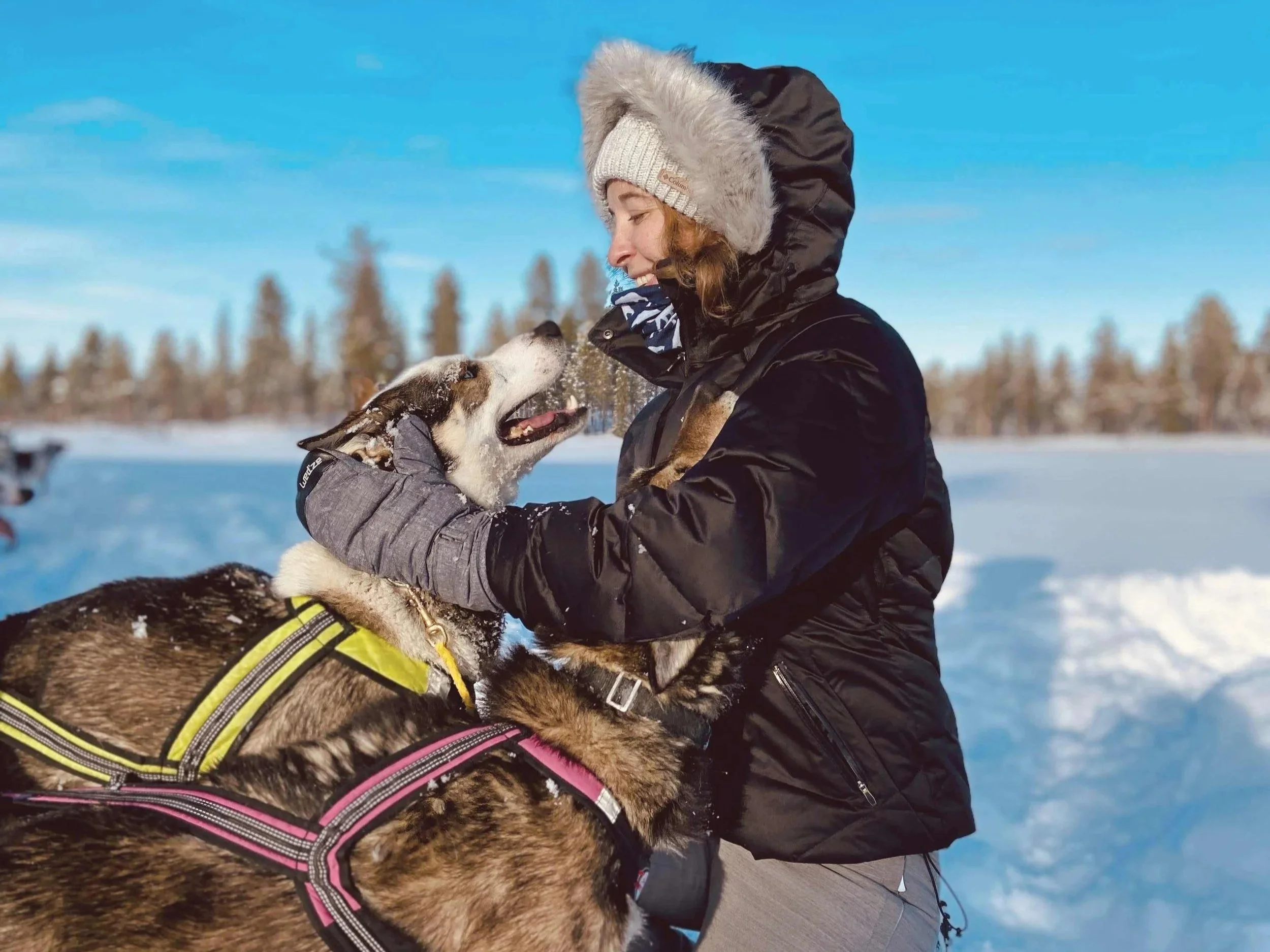
Layers might not be flexible for cuddling with sled dogs, but you’ll be happy you have them for aurora waiting! Here near Kiruna.
Northern Swedish winters run cold enough (and by cold, we mean -30ºC or colder at times) that layering matters more than any single item: a base layer, an insulating mid-layer, a windproof and insulated outer layer, insulated boots, thick socks, and mittens with thin touchscreen gloves underneath for photos. Full packing list in our What to Wear for a Northern Lights Trip guide.

Penguin tip:
High season in Swedish Lapland is actually winter. If you’re planning to visit in February or March, we recommend booking 3–6 months ahead — especially for Abisko and Kiruna. Accommodation options are limited and can get very expensive.
✈️ Find flights
🏨 Explore hotels, apartments, guesthouses, cabins
🧭 Browse activities and tours
🚗 Compare car rentals
🧳 Get travel gear
🛡️ Travel safe with Heymondo Travel Insurance (5–15% off)
📱 Get a travel eSIM
🐾 Protect & track Arctic wildlife with Fahlo Bracelets (20% off)
FAQ: Northern lights tours in Sweden
Can you see the northern lights in Sweden? Yes, especially across northern Sweden (Kiruna, Abisko, Luleå), which sits inside or close to the auroral oval for much of the year. There's no guarantee on any single night, since it depends on both solar activity and cloud cover, but the season runs late August through early April, with December to March offering the best combination of darkness and stable weather.
Where's the best place to see the northern lights in Sweden? Kiruna for infrastructure and variety, Abisko for the clearest skies thanks to its Blue Hole microclimate, and Luleå for a quieter, more affordable coastal base. Many travelers combine Kiruna with an Abisko evening.
When is the best time to see the northern lights in Sweden? Late August through early April, with December through March giving you the longest, darkest nights and generally the most stable weather.
Is there a forecast or tracker for the northern lights in Sweden? The Swedish Institute of Space Physics, based in Kiruna, publishes a free IRF Aurora Alert app. Beyond that, pair a KP-index tracker with a local cloud cover forecast for your exact night and location, rather than relying on a single all-in-one score. Aurora forecasting is short-range, usually just a few hours to a couple of days ahead, so don't plan a whole trip around a long-range prediction.
What are the chances of seeing the northern lights in Sweden? We don't have a verified figure for this, and we'd be cautious of any source that quotes one confidently, aurora forecasting is short-range and imprecise. Staying at least three nights meaningfully improves your odds over a single night.
Do I need a tour to see the northern lights in Sweden? No. The outskirts of Kiruna, the Abisko area, and dark stretches of coast near Luleå are all accessible without a guide, especially with a rental car. A tour helps most if you're short on time or don't want to drive in Arctic winter conditions.
Is Abisko really better than Kiruna for the northern lights? Abisko tends to have clearer skies thanks to its Blue Hole microclimate. Kiruna has far more infrastructure and things to do if the sky doesn't cooperate. Many travelers base themselves in Kiruna and add a night or an evening tour in Abisko.
Do I need a rental car to see the northern lights in Sweden? Not for a tour, most include pickup. But a car gives you the freedom to chase clear sky on your own schedule, and to move between Kiruna, Abisko, and Luleå if you're combining destinations.
Can you see the northern lights from Stockholm? Stockholm sits far enough south that displays are rarer and generally weak compared to Swedish Lapland. That said, my first-ever aurora sighting was in Borlänge, a couple of hours from the capital, so it's not impossible. The odds are just a lot less in your favor that far south.
Wherever you end up, Kiruna, Abisko, or Luleå, it's still a matter of luck (like anything in nature). So, pick the base that fits your itinerary, build in a few nights, and let Mr. Weather (and Lady Aurora/Lord Sun), decide if you’re in for a treat!
Finally, explore all our Lapland Travel Guides here.
Planning a Northern Lights Trip? ✨
Get a free aurora checklist straight to your inbox.
No spam. Just northern lights strategy (and occasional penguin energy).
Thank you, little penguin! 🐧
Check your inbox — our best Northern Lights tips are on the way.
Best Hotels in Kiruna
ICEHOTEL Sweden
Things to Do in Kiruna & Swedish Lapland Year Round
Things to Do in Kiruna in Winter
Northern Lights in Kiruna
Northern Lights Tours in Kiruna
Car Rental in Kiruna
Abisko:
Abisko Northern Lights Tours
Best Hotels in Abisko
How to Get to Abisko from Kiruna
Luleå Northern Lights
Hotels in Luleå, Sweden
Winter Travel to Luleå
Swedish Lapland in general:
Best Hotels in Swedish Lapland
Northern Lights Tours in Sweden
Best Time to Visit Lapland
Northern Lights in Lapland
One Lapland Trip, Three Countries
Our Ultimate Arctic Travel Guide
Northern Lights for Dummies
