
Everything we saw in two days inside the park, from boardwalks and short walks to bison in the road.
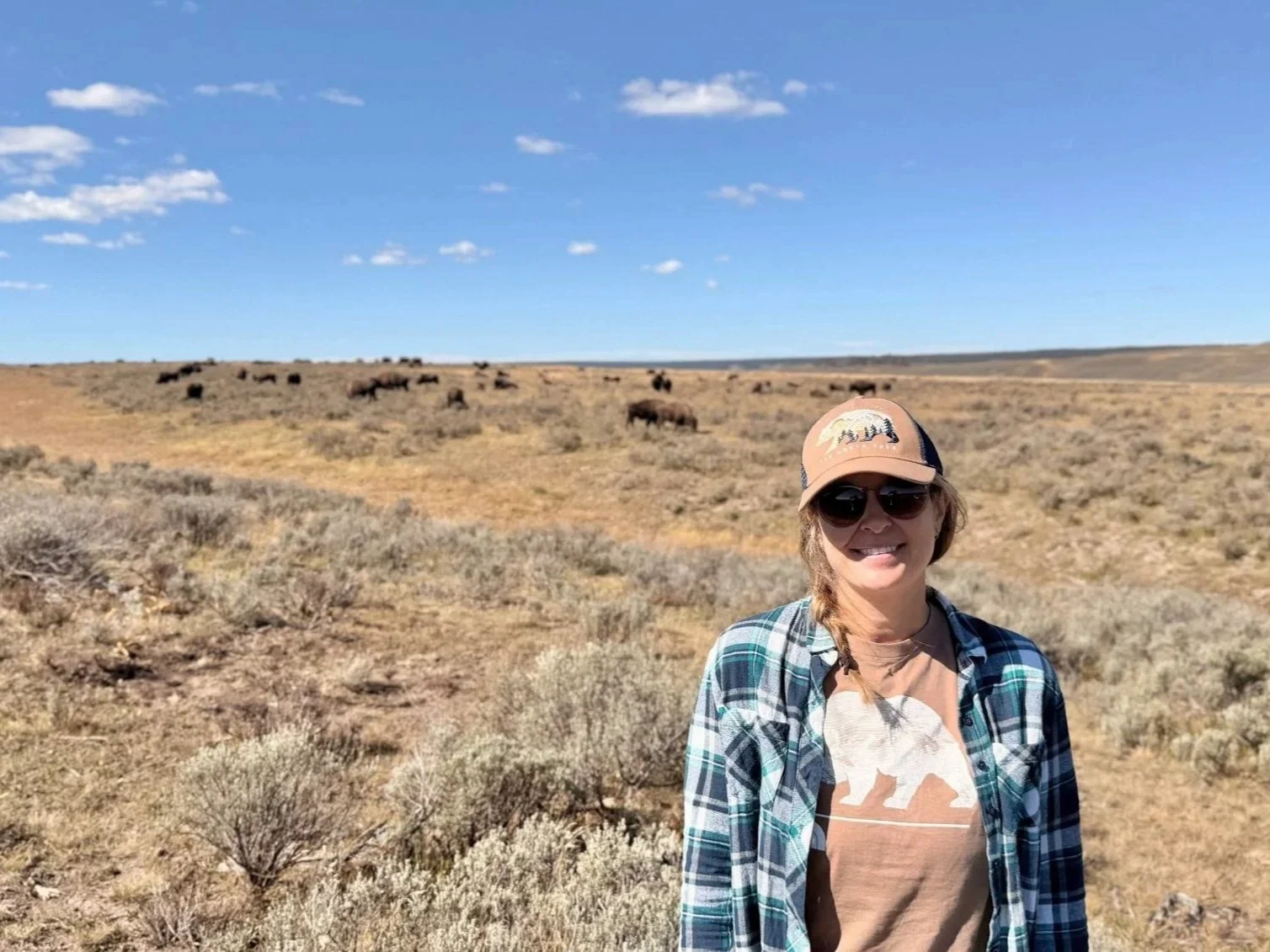
Did anybody say bison?
Most lists of Yellowstone things to do include hikes, and this is usually our go-to. However, this time, we had to adjust our itinerary around boardwalks, overlooks, and short walks, as we were traveling with family.
This guide covers what we did and how hard each stop is, based on our two visits (one camping years ago, and another one in September 2026). For a day-to-day plan, see our Grand Teton and Yellowstone Itinerary for Non-Hikers.
🛌 Where to stay:
• Explorer Cabins at Yellowstone, West Yellowstone — Contemporary cottages with kitchenettes, less than a mile from the West Entrance.
• Yellowstone Gateway Inn, Gardiner — Two minutes by car from the North Entrance, next to Gallatin National Forest.
• The Cody, Cody — A base for the East Entrance, with an indoor pool and a microwave and refrigerator in every suite.
🇺🇸 Top experiences:
• Full-day Yellowstone wildlife safari in Lamar Valley from Bozeman — A guided day in the part of the park known for wildlife watching.
• Lamar Valley wildlife van tour from West Yellowstone — The same valley as a van tour, leaving from the West Entrance town.
🚗 Compare car rentals at Bozeman airport — Every gateway town here is a drive from the airport, and you will want a car inside the park too.
Jump to: Geysers · Easy hikes · Wildlife · Canyon and Mammoth · Beyond the park · Guided tours · FAQ
Things to do in Yellowstone for non-hikers: quick answer
The best things to do in Yellowstone without hiking are the geyser basins, which are reached on boardwalks, the wildlife along the roads in Hayden Valley, and the Grand Canyon of the Yellowstone from its overlooks. If you want a few easy hikes, the Grand Prismatic Overlook trail at 1.2 miles round trip and the Porcelain Basin loop at Norris at 0.75 miles are our picks. Add Mammoth Hot Springs if your group can handle stairs, and a soak in the Madison Valley outside the park if everyone wants a slow day. Everything is driveable, and distances inside the park are long, so build in extra time. Our itinerary shows how we fit it together.
Geysers and hot springs on the boardwalks
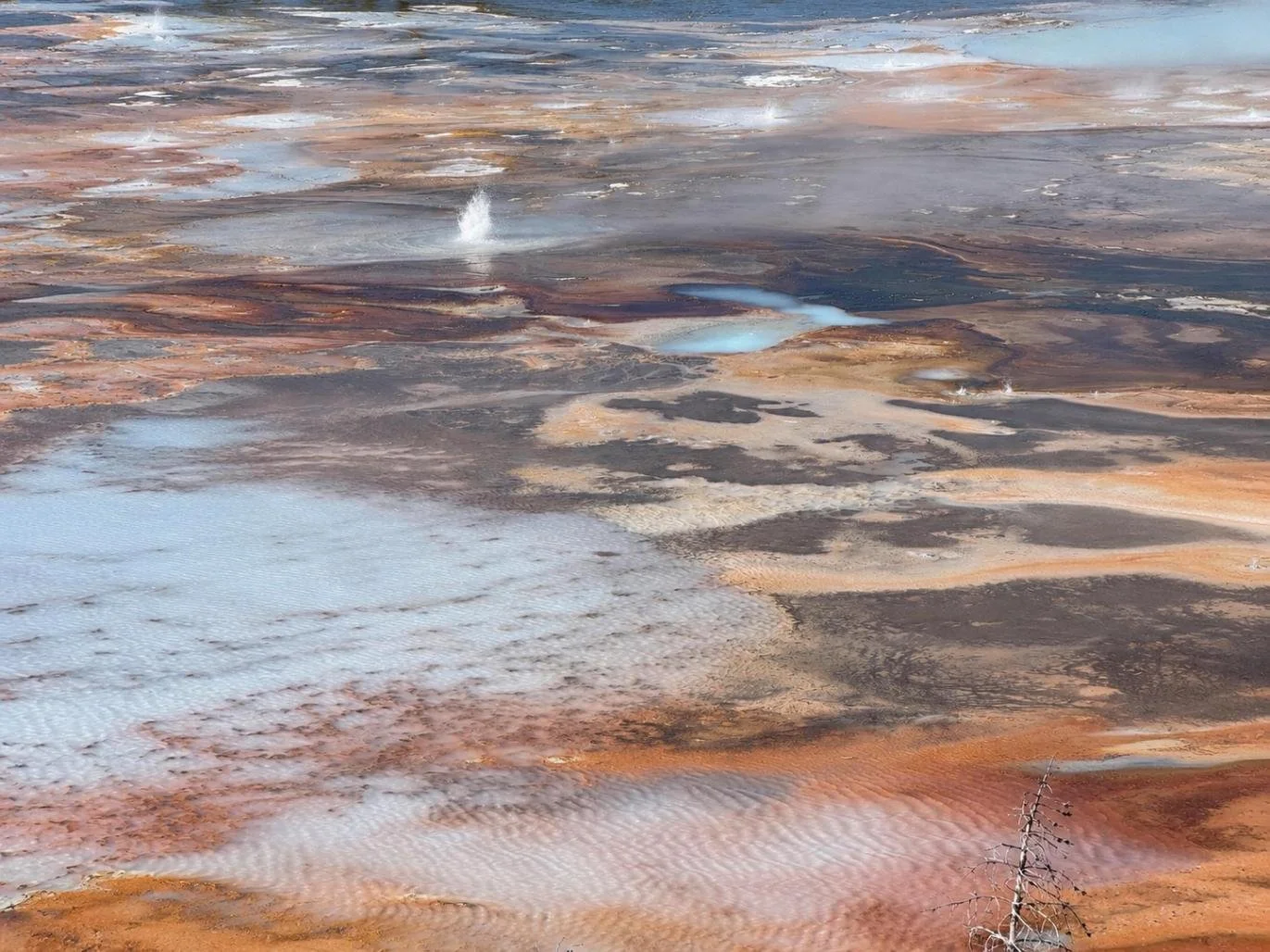
These little geysers at Porcelain Basin are constantly erupting!
This is the best part of Yellowstone for people who don't hike, because the biggest sights come with a boardwalk and a parking lot. Also, this is the largest geothermal display we’ve ever seen, beyond Iceland. We did all of this in two days, mostly along a single road, as covered in our itinerary. Stay on the boardwalks: the ground and water in thermal areas can cause severe burns, and even death.
Old Faithful and the Upper Geyser Basin
Effort: wide, wheelchair accessible walkways from the visitor center and every parking area. Plan on 30 to 90 minutes.
Old Faithful erupted about ten minutes after we parked, which was luck in our case. However, you can plan for it, since rangers predict its eruptions (more or less, give the old guy some slack). The viewing area is a semicircle less than a quarter mile from the Visitor Education Center. The Upper Geyser Basin around it holds at least 150 geysers within a single square mile, and rangers also predict several of the bigger ones, including Castle, Grand, Daisy, and Riverside.
Midway Geyser Basin and Grand Prismatic Spring
Effort: an accessible boardwalk, accessible parking, and accessible restrooms. Six miles north of Old Faithful.
The boardwalk takes you to Grand Prismatic Spring, the largest hot spring in Yellowstone, which is roughly 200 to 330 feet across and more than 121 feet deep. And the color is amazing. Next door, Excelsior Geyser is a crater about 200 by 300 feet that sends more than 4,000 gallons of water a minute into the Firehole River.
Fountain Paint Pot
Effort: about half a mile of boardwalk, level at the start and steeper with stairs further along. Eight miles north of Old Faithful.
One short loop fits in all four kinds of thermal feature: mudpots, fumaroles, hot springs, and geysers. The first stretch is wheelchair accessible, with easy access to Silex Spring. Anyone who prefers to skip the stairs can turn around where the level part ends.
Norris Geyser Basin
Effort: two boardwalk loops, Porcelain Basin at 0.75 miles and Back Basin at 1.5 miles.
We stopped at Norris on the drive home and walked Porcelain Basin, which is bare ground and boardwalk. Back Basin is more wooded, with features scattered along the loop, and it's also easy. Norris is also home to Steamboat Geyser, the tallest geyser in the world, with major eruptions of roughly 300 to 400 feet that are unpredictable and often years apart. If that happens when you’re there, you probably should play the lottery!
Mammoth Hot Springs
Effort: steep grades and stairs on the terrace trails. The route between the Lower and Upper Terraces is rated as strenuous (probably not by Norwegian standards).
Mammoth has several hundred of stairs between the Lower and Upper Terraces, but walking to the Lower Terraces is very easy. The tops of Canary Springs and Palette Springs are wheelchair accessible when there's no snow on the ground. Upper Terrace Drive, a one-mile loop that shows the terraces from the car, is listed as a summer road. If you stay in nearby Gardiner, our Yellowstone hotel guide covers where to sleep on that side.
Easy hikes in Yellowstone: the short walks we did
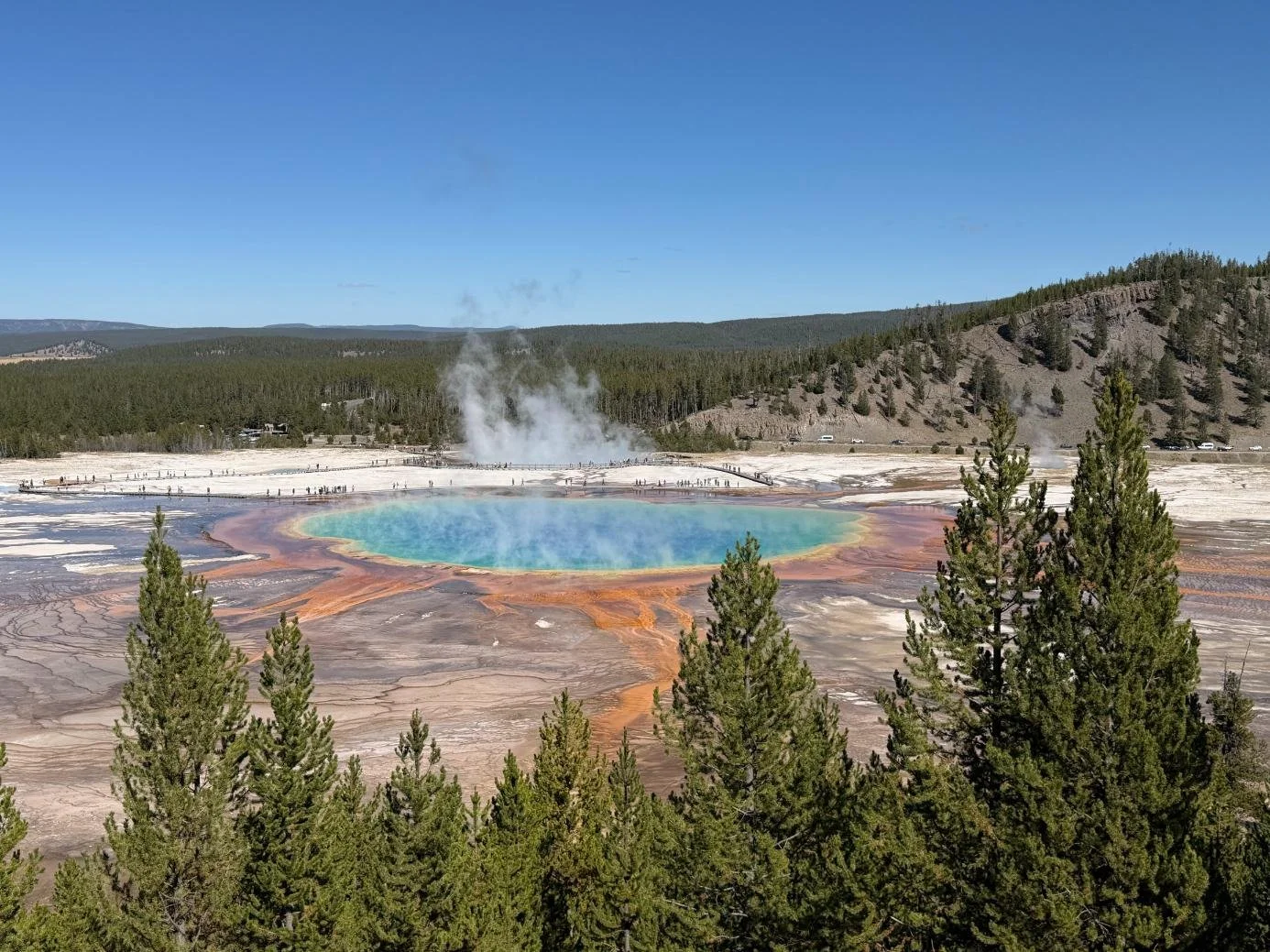
The grand, Grand Prismatic from the viewpoint
If you’ve been following us for a while, you probably know we’re avid hikers. So we wouldn’t consider the walks below as hikes, but some people do. The trails below are short, mostly flat or gently graded, and doable in less than an hour, depending on your pace of course.
Grand Prismatic Overlook trail
Distance: 1.2 miles round trip, with a gradual climb of about 105 feet.
This is the best of the easy Yellowstone hikes for a view, because it shows you the whole spring from above, which the boardwalk can't. We’ve done both and would recommend the overlook if you only have time for one. The trail starts at the Fairy Falls parking lot, about a mile south of Midway. It's short, but it isn't flat, and parking is very limited. If someone in your group uses a wheelchair or a walker, the Midway boardwalk is the better choice.
Porcelain Basin at Norris
Distance: 0.75 miles of bare ground and boardwalk.
The shortest of the Norris loops, and the one we walked. It's open ground with almost no trees, so there's little shade in summer. The other loop, Back Basin, is 1.5 miles and more wooded.
Fountain Paint Pot and the Midway boardwalk
Distance: about half a mile at Fountain Paint Pot, and a short boardwalk at Midway.
These are boardwalks more than hikes, but they work for a mixed group. We've covered both in the geyser section above.
Parking and timing
Parking areas at the summer thermal sites get crowded, and we’d recommend visiting at off-hours if you can. The Fairy Falls lot is the tightest. If it's full, do Fountain Paint Pot and Midway first and try the overlook again on your way out.
Wildlife you can watch from the car
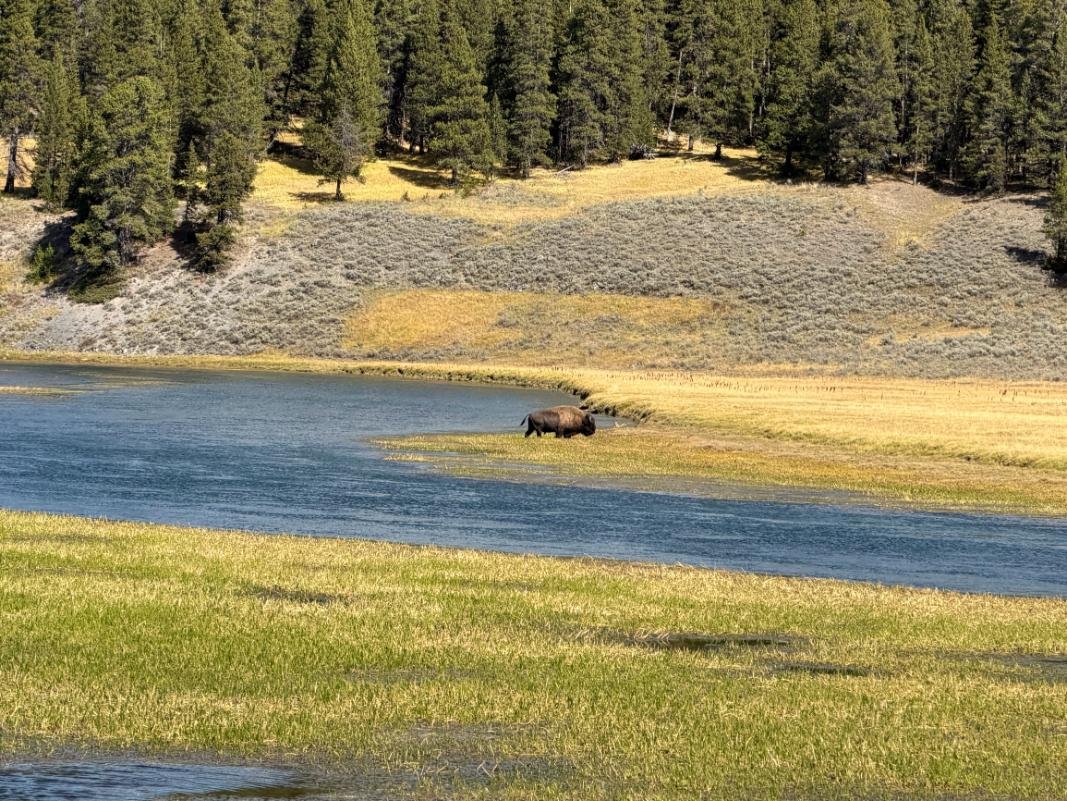
Bison in Hayden Valley in September
You don't need a trail to see animals in Yellowstone, and that’s the beauty of many regions of North America. At times, it feels a bit like a safari more than a wilderness experience given the number of cars on the road, but it’s a great way for people with reduced mobility to see wildlife in their natural habitat.
Hayden Valley
Hayden Valley is marshy, nearly treeless ground that was once part of an arm of Yellowstone Lake. It’s considered one of the best places in the lower 48 to see grizzly bears, bison, and elk. We were there for the bison, and the bison were definitely there.
The entrance road and Mammoth
Infall, bison herds love the meadows along the Madison and Gibbon rivers and often use the entrance road, and elk gather between Seven Mile Bridge and Madison Junction during the rut. Elk also live in Mammoth village year-round. We saw both bisons and elks.
Keep your distance
Bison have injured more people in Yellowstone than any other animal. Stay at least 25 yards from bison and elk and 100 yards from bears and wolves (if you’re lucky enough to see one), drive carefully around the herd, and never stop in the roadway. If you're wondering about Lamar Valley, we didn't make it there on our latest trip, but it's the part of the park most people point to for wildlife. The guided tours in our quick picks both go there.
The Grand Canyon of the Yellowstone

Artist Point behind us, Lower Falls in front of us!
Effort: overlooks and roadside viewpoints, with an accessible trail on the North Rim.
It might not be THE Grand Canyon, but what a beautiful, grand Canyon it is.
It’s roughly 20 miles long and more than 1,000 feet deep, with walls that are gray and yellow from altered rock. The Lower Falls drop 308 feet and the Upper Falls 109, and because the canyon bends between them, you can't see both from one spot. The longest stretch of accessible trail begins at the Lookout Point and Grand View parking lots on the North Rim. On the South Rim, the road ends at the Artist Point parking area, with a view of the Lower Falls and the stunning Artist Point colors.
Beyond the park: hot springs to swim and ghost towns
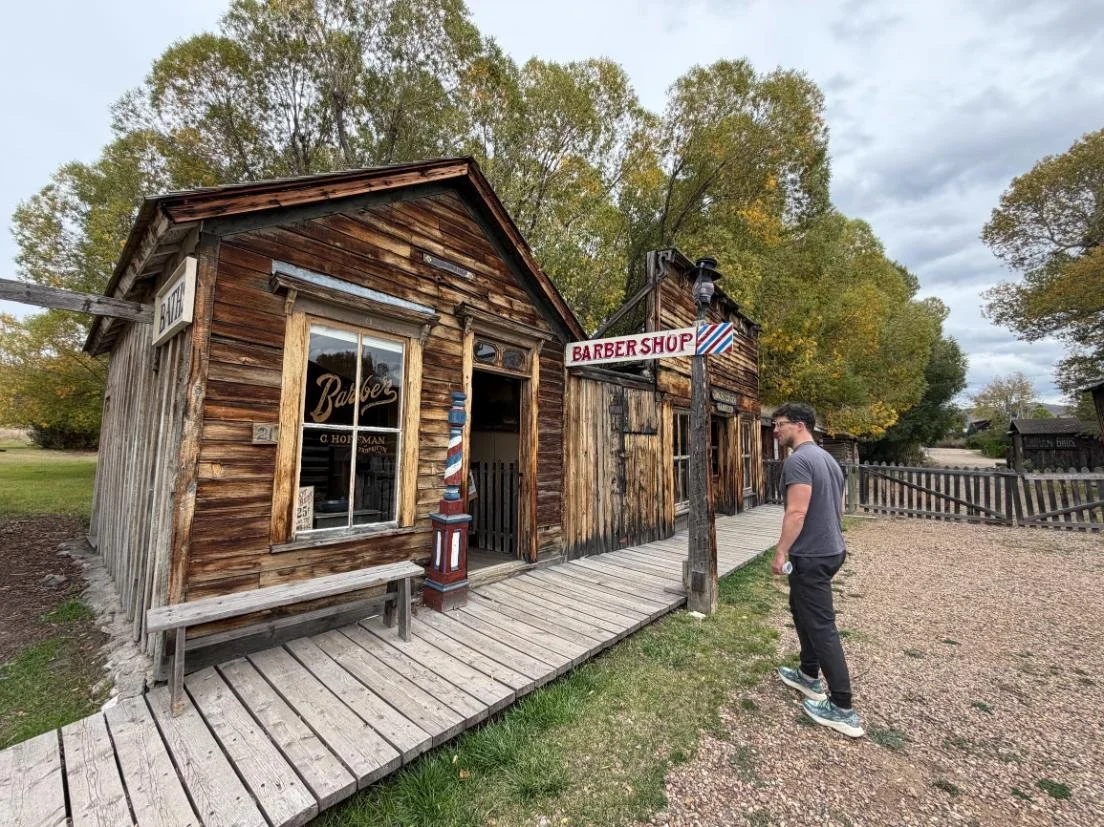
Exploring Nevada City is like being in a Western movie!
After a long day in the car, we gave the car a break. Day 3 of our itinerary stayed in the Madison Valley, and it made a good counterweight to two big park days. If you're staying in Ennis or West Yellowstone, it's worth planning one.
Norris Hot Springs
Not to be confused with Norris Geyser Basin in the park, Norris Hot Springs is a hot spring in the town of Norris, Montana, on Highway 84, about 16 miles from Ennis. Mineral water rises from underground at about 120 degrees Fahrenheit into a historic wooden pool, and there's a restaurant (farm-to-table) and bar with a really cool vibe on site. It isn't open every day of the week, so check the hours before you drive over.
Virginia City and Nevada City
Gold was found in Alder Gulch in May 1863, and Virginia City was the capital of Montana Territory from 1865 to 1875. Today the state-run Montana Heritage Commission looks after the historic district, with preserved buildings, Boot Hill, and a narrow-gauge railroad that runs to Nevada City. Opening dates change with the season. Both cities were super cool to visit and walk around.
Zoom in and out on the map below to find hotels, cabins and lodges around Yellowstone:
Guided tours in Yellowstone

Aren’t they cute (from afar)?
We drove ourselves, and the longest day took about three and a half hours each way from Ennis to Mammoth before any stops. That's a lot of driving, and it's the reason some visitors prefer a guided day. A tour makes sense if you don't want to drive park roads, if you want a guide to spot wildlife, or if you're short on time. We're preparing a full guide to Yellowstone tours, organized by where you start.
Browse Yellowstone tours:
✈️ Find flights
🏨 Explore hotels, apartments, guesthouses, cabins
🧭 Browse activities and tours
🚗 Compare car rentals
🧳 Get travel gear
🛡️ Travel safe with Heymondo Travel Insurance (5–15% off)
📱 Get a travel eSIM
🐾 Protect & track American wildlife with Fahlo Bracelets (20% off)
FAQ: Things to do in Yellowstone without hiking
What are the best things to do in Yellowstone without hiking?
The geyser basins, which are reached on boardwalks, the wildlife in Hayden Valley, and the Grand Canyon of the Yellowstone from its overlooks. Mammoth Hot Springs adds stairs, so skip it if your group can't manage them.
Are there easy hikes in Yellowstone National Park?
Yes. The Grand Prismatic Overlook trail is 1.2 miles round trip with a gradual climb of about 105 feet, and the Park Service rates it easy. Porcelain Basin at Norris is 0.75 miles, and Back Basin is a 1.5 mile loop. Fountain Paint Pot is about half a mile of boardwalk.
What are the best easy hikes in Yellowstone?
For a view, the Grand Prismatic Overlook trail. For a first look at geysers and hot springs, Fountain Paint Pot and Porcelain Basin at Norris. These are the ones we walked, and none takes more than a couple of hours.
Is Yellowstone wheelchair accessible?
Parts of it are. The Park Service lists wheelchair accessible walkways from the visitor center and every parking area to Old Faithful, an accessible boardwalk and parking at Midway Geyser Basin, and a level, accessible first stretch at Fountain Paint Pot. The longest accessible trail at the canyon begins on the North Rim, and the tops of Canary Springs and Palette Springs at Mammoth are accessible when there's no snow.
How many days do you need in Yellowstone if you don't hike?
We did two days inside the park, and it was tight given the distances. Three days gives you room for the geysers, Hayden Valley and the canyon, and Mammoth, without spending every hour in the car.
Can you see Yellowstone wildlife from the car?
Yes. Hayden Valley and the entrance roads are good for bison and elk, and the Park Service lists Hayden Valley as one of the best places in the lower 48 to see grizzly bears, bison, and elk. Stay 25 yards from bison and elk and 100 yards from bears and wolves.
Is a guided tour worth it for Yellowstone?
It depends on how you feel about driving. We drove ourselves, and our longest day took about three and a half hours each way before any stops. A tour makes sense if you don't want that drive or want a guide for wildlife. We haven't taken one, so check recent reviews for the tour you're considering.
When should you arrive for an Old Faithful eruption?
The Park Service suggests arriving at least ten minutes ahead, and rangers predict its eruptions. Plan on 30 to 90 minutes for the whole visit.
You don't need to hike to visit Yellowstone. You need a car, a rough idea of where the stairs are, and some patience for bison. Pick the walks that fit your group, and leave the rest for the next trip (we have a few hikes in store for next time!).
And if you need a place to stay, read our guide to Yellowstone Hotels & Cabins by Entrance. Want to continue on to Grand Teton? Read our Yellowstone & Grand Teton Itinerary.
Finally, explore all of our USA Travel Guides here.

Free download
Travel Cheaper Cheat Sheet
27 tips on flights, hotels, hidden costs and more — spend less without missing what actually matters.
No spam. Unsubscribe anytime.
