
Northern Lights in Greenland: When to Go, Best Spots & What Makes it Different
One of the world's greatest aurora destinations — and nobody talks about it
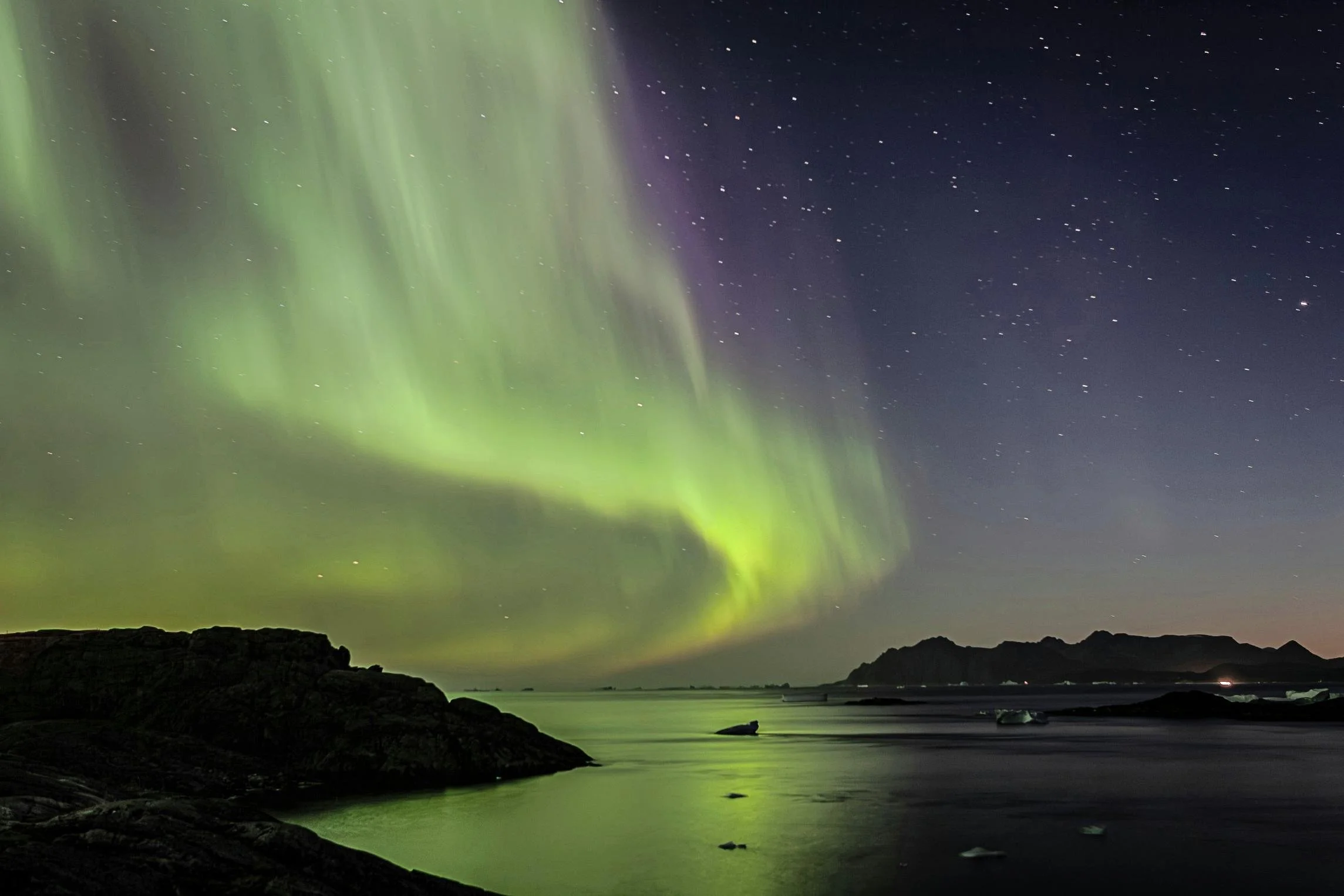
Northern lights over Ammassalik, East Greenland — Photo credit: Nick Russill
Last update: August 2026
Most people chasing the aurora fly to Iceland or Norway. A smaller group goes to Lofoten. Almost nobody thinks of Greenland for the northern lights (hence this guide)— which is, depending on how you weigh the variables, one of the best decisions any aurora hunter could make. The country spans from 60°N to 83°N, sits squarely inside the auroral oval across most of its territory, has almost no light pollution, and offers a sky backdrop that no other northern lights destination in Europe can match: icebergs the size of apartment buildings, lit green from above.
The reason Greenland doesn't dominate aurora travel lists is the same reason it doesn't dominate any travel list — getting here requires a deliberate decision, not a budget flight from London. But for those who make that decision, Greenland northern lights are a different category of experience.
So what does it actually take to see the northern lights in Greenland — and is it worth the effort compared to Iceland or Norway? Here’s how to think about it, the best spots, when to go, and how to plan it properly.
🛌 Nuuk:
• Hotel Hans Egede — Nuuk's most iconic hotel, tallest building in the city, panoramic views.
• HOTEL SØMA Nuuk — sea views, local feel, right by the harbor and cultural center.
• Eagle View — sweeping fjord and mountain views, great value, stylish apartments.
🛌 Ilulissat:
• Cabin Jomsborg, Ilulissat Stay — we stayed here. Ten meters from the water, icebergs drifting past the kitchen window.
• Hotel Hvide Falk — Greenland's oldest hotel, Disko Bay views, exceptional local cuisine.
• Best Western Plus Hotel Ilulissat — newest hotel in town, rooftop restaurant, airport transfers included.
🇬🇱 Top experiences:
• Browse Greenland tours — icefjord boat trips, whale watching, fjord hikes, northern lights excursions.
Quick navigation: Why Greenland? · When to go · Best spots · How to forecast · Guided tours · Photography · Where to stay · FAQ
Is Greenland a good destination for the northern lights?
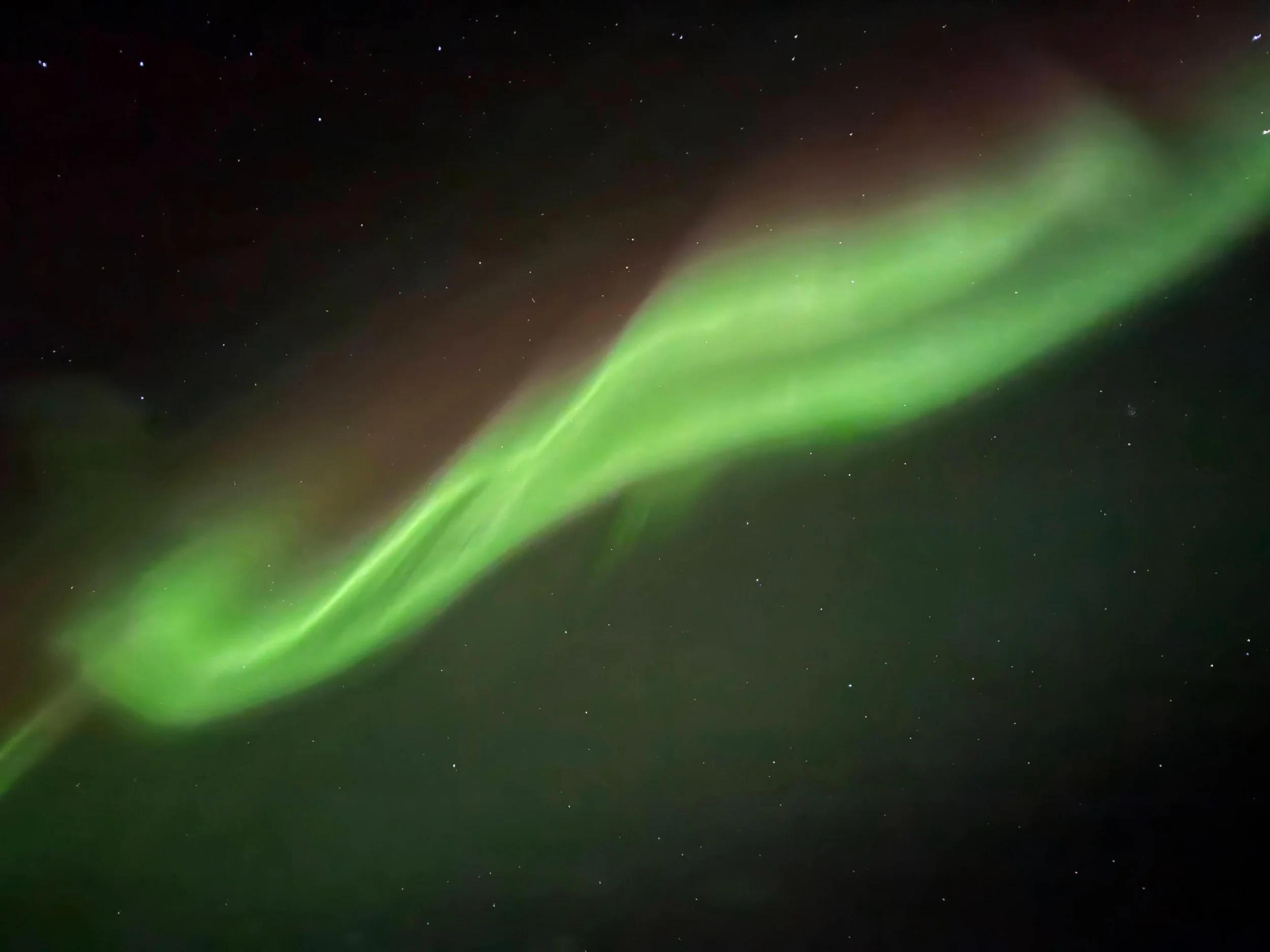
Greenland’s latitude allows regular overhead displays like this one
Yes! Greenland is a great place for northern lights, and its aurora advantage starts with geography. Unlike the Faroe Islands, which sit south of the auroral oval and need a KP of 3 to 4 before the lights appear, most of Greenland sits inside the oval. Nuuk, the capital, is at 64°N — similar latitude to Lofoten and inside the zone where a KP of 2 to 3 produces visible aurora on a clear night. Ilulissat, further north at 69°N, is deeper still, and the lights there can appear overhead at low activity levels that wouldn't register at all further south (more on that in our article: What are the northern lights).
The second advantage is sky clarity. Lofoten and Iceland, for example, are exposed to North Atlantic weather systems that make cloud cover a near-constant obstacle. Greenland's west coast, and particularly its inland areas, tends toward drier, clearer winter conditions — especially away from the coast. Kangerlussuaq, the inland transit hub on the west coast, averages more clear nights per year than almost any other inhabited place in the Arctic.
The third advantage is the backdrop. Iceland has the aurora over volcanoes and lava fields. Lofoten has it over fishing villages and peaks. Lapland has forests and lakes. Greenland has it over icebergs — and that combination doesn't exist anywhere else on earth.
Note before you chase the northern lights: Greenland is remote, wild, and full of surprises — which is exactly why we love it. But a sprained ankle while trying to run for an aurora selfie can get expensive fast. We always travel with Heymondo Travel Insurance, and you get 5% off (sometimes up to 15%) through our link.

Penguin Trampoline tip:
Greenland has roughly 56,000 people spread across a country three times the size of Texas (our definition of paradise). Light pollution is not a problem you will have here. Almost anywhere outside the small towns is as dark as the sky gets.
When to see the northern lights in Greenland — month by month
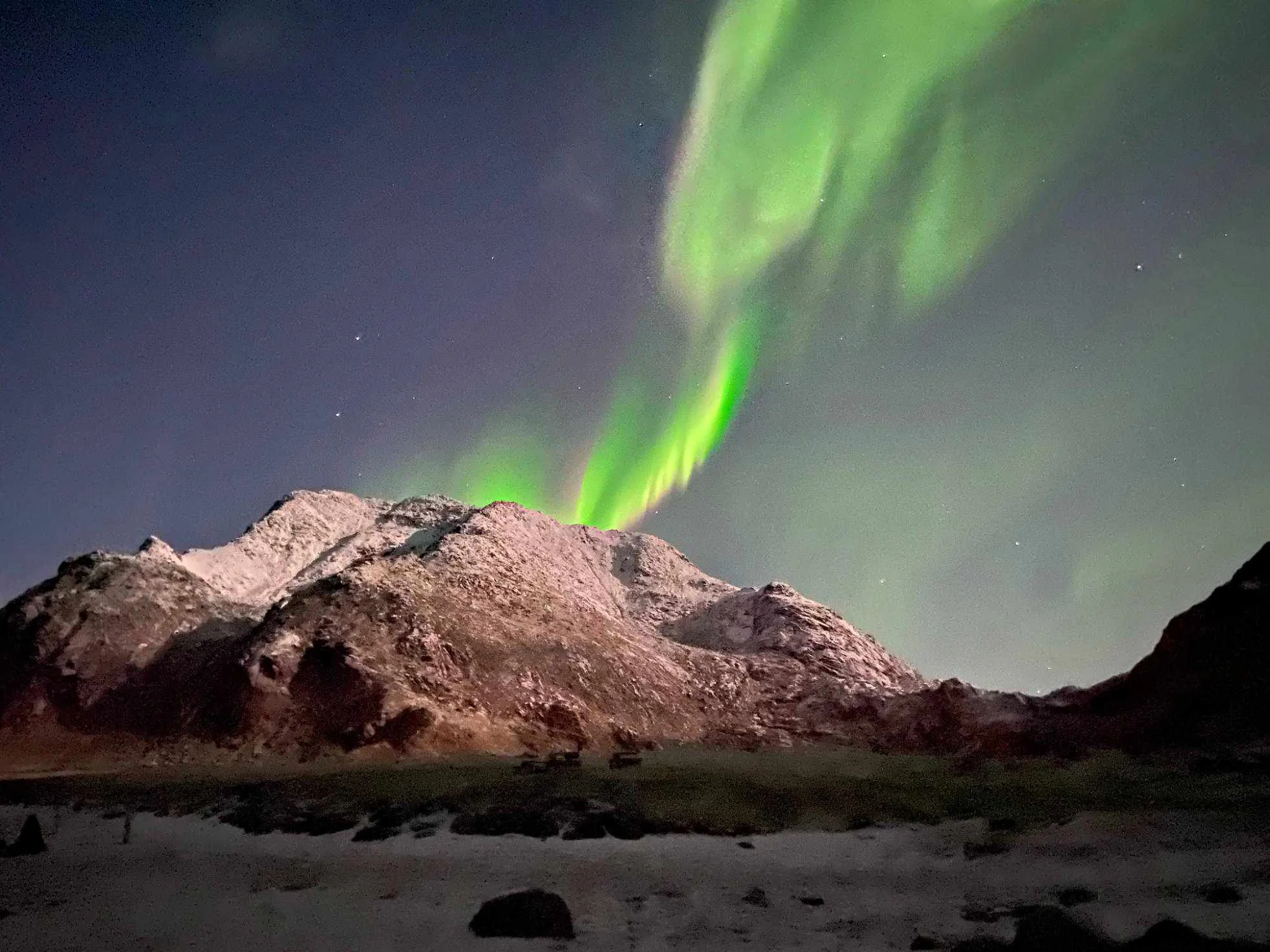
We took this photo in October
The aurora season in Greenland runs from late August through mid-April, when nights are dark enough for the lights to be visible. Within that window, timing shapes both the aurora chances and the overall experience significantly. Read our guide to the best time to see the northern lights for detailed information.
September and October offer the equinoctial advantage — geomagnetic activity tends to peak around the equinoxes, and the combination of returning darkness and relatively stable late-summer weather makes these underrated months. September still has reasonable temperatures and the landscape transitions from summer green to early Arctic winter. Aurora activity can be strong even at modest KP levels given Greenland's latitude.
November and December bring long, dark nights and the full onset of winter. By December, Ilulissat receives only a few hours of twilight per day — extended darkness that maximizes viewing opportunity. Temperatures drop significantly and travel logistics become more demanding, but the aurora windows are among the longest of the year.
January and February are the coldest months, with temperatures regularly reaching -20°C in inland areas, but the skies are often exceptionally clear. The frozen fjords and snow-covered icebergs create a winter landscape that is otherworldly in a way that summer Greenland simply isn't. Read our guide to packing for Greenland to make sure you don’t freeze :-)
March is the strongest single month across most aurora destinations at northern latitudes, and Greenland is no different. A second equinoctial boost to geomagnetic activity, improving weather as the worst of winter eases, and still-long nights make March the sweet spot. You can dog sled by day and chase aurora by night. If you have any flexibility, this is when to go.
Book at least five nights. As with every aurora destination, cloud cover is the main obstacle and it doesn't cooperate with short itineraries.
For everything Greenland offers beyond the aurora across all seasons — icebergs, hiking, the ferry route south — our best time to visit Greenland guide covers the full picture.
Best spots to see the northern lights in Greenland
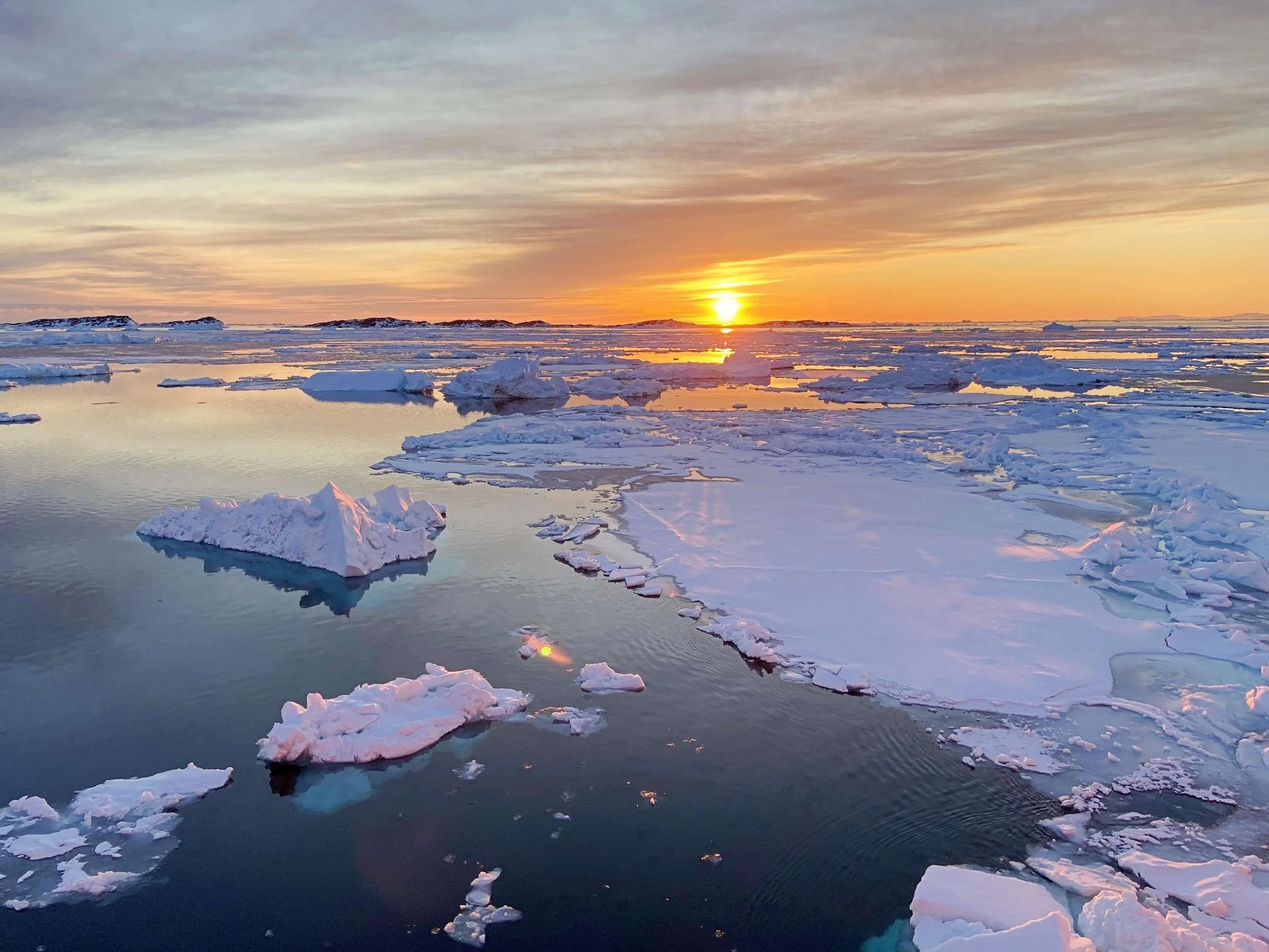
The sunset was already spectacular… can you imagine with northern lights? Here on the ferry between Nuuk and Ilulissat
Greenland's scale means viewing opportunities are different depending on where you base yourself. Three locations stand out for distinct reasons.
🌊 Ilulissat — aurora over the icefjord
Ilulissat is the most visually spectacular aurora location in Greenland and one of the most remarkable on earth. The town sits at 69°N, well inside the auroral oval, with the UNESCO World Heritage Ilulissat Icefjord — one of the most productive glaciers in the Northern Hemisphere — directly below the sky. When the lights appear over the icefjord, they reflect off surfaces that exist nowhere else: blue-white iceberg faces, frozen fjord water, the calving front of Sermeq Kujalleq glacier. Photographers who have shot aurora across Iceland, Norway, and Canada describe this as the image that supersedes everything else.
Getting away from Ilulissat's modest town lights takes ten minutes on foot. The ridge above the icefjord facing northwest, the harbor viewpoint, and the walking trails along the fjord edge are all strong positions. Given Ilulissat's latitude, even moderate aurora activity produces overhead displays rather than horizon glow.
Sounds tempting? Read our Ilulissat guide to plan your stay.
🛫 Kangerlussuaq — the clear sky capital
Kangerlussuaq is primarily known as Greenland's main international transit hub, but aurora hunters who know about it treat it as a destination in itself. Located inland on the west coast at 67°N, away from coastal moisture, it has some of the clearest winter skies in the entire Arctic. The surrounding landscape — frozen lakes, tundra, the edge of the ice sheet — provides an austere but compelling foreground, and the absence of light pollution is total. If your Greenland itinerary routes through Kangerlussuaq anyway, building in an extra night specifically for aurora is a decision you will not regret.
🏙️ Nuuk — accessible, underrated
Nuuk sits at 64°N and has enough light pollution in the city center to require a short drive (or even walk if you’re up for it), but fifteen minutes in any direction puts you in conditions that would qualify as excellent at any other aurora destination. The fjord system around Nuuk — icebergs drifting past dark headlands, the mountains of Sermitsiaq visible to the west — gives you strong foreground without the logistical complexity of reaching Ilulissat. For visitors combining aurora with the cultural and urban sides of Greenland, Nuuk is the practical base. Our Nuuk guide covers the capital in full (spoiler alert, we love it).
🐧 Penguin Trampoline tip: The road system in Greenland doesn't connect towns — there are no roads between settlements. Aurora chasing here means working within the area around your base, not driving toward a clearer sky in the next town. Choose your base carefully based on where you want the lights to appear.
🐻❄️ Far north in coastal Greenland, the ice belongs to the polar bear. You might not see one — but knowing they’re out there changes how you see the Arctic.
If you’d like to help protect them, Fahlo’s Polar Bear Bracelet supports polar research and lets you follow a real bear’s journey across the ice.
🐾 Use our link for 20% off your bracelet: Track a polar bear with Fahlo
How to forecast a northern lights night in Greenland
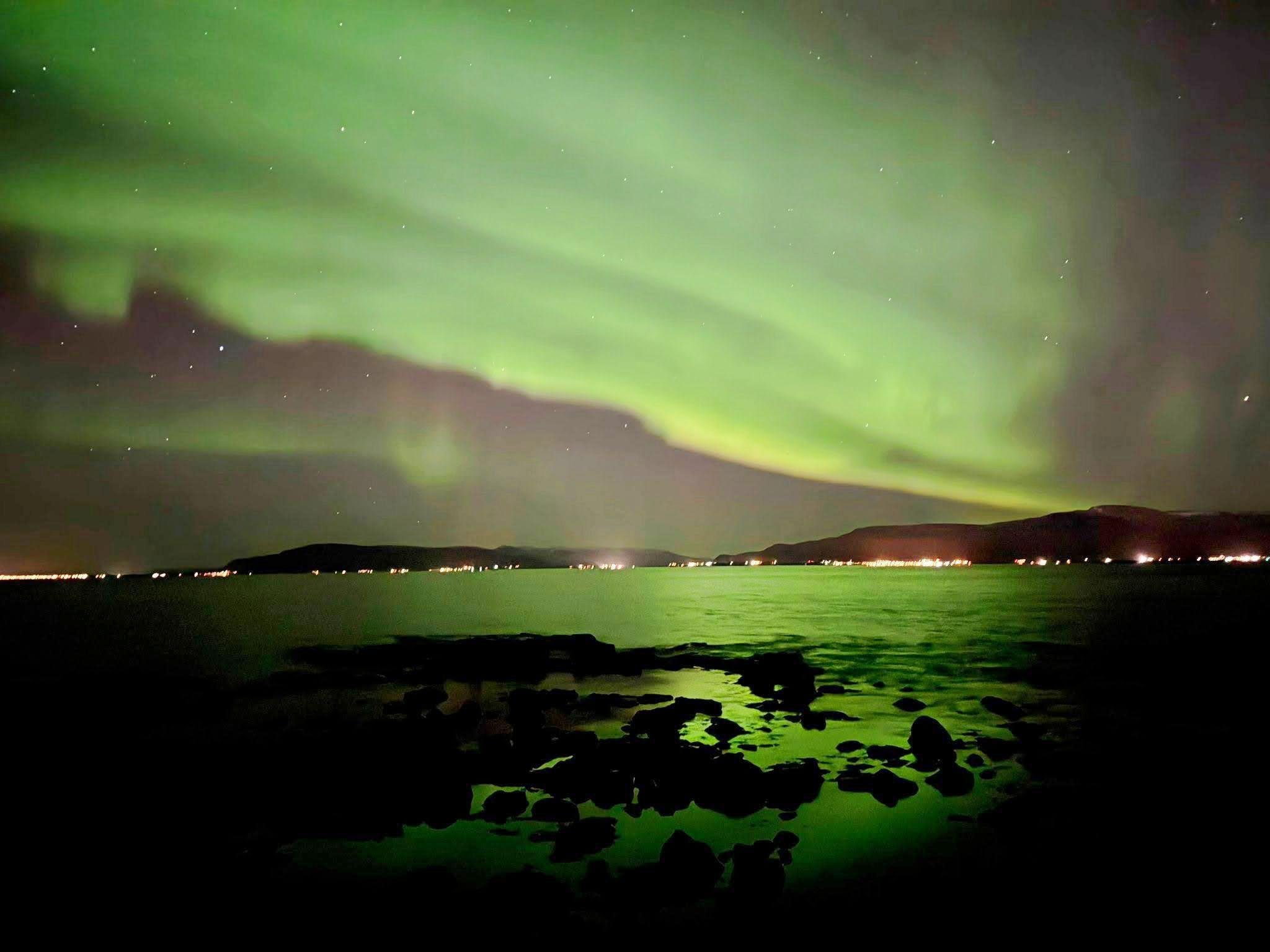
This was KP 3
Aurora forecasting in Greenland follows the same two-variable logic as everywhere else — geomagnetic activity and cloud cover — but the balance shifts in your favor here compared to most destinations.
For KP index: At Ilulissat's latitude (69°N), even a KP of 1 to 2 can produce visible aurora on a clear night. At Nuuk (64°N), KP 2 to 3 is the practical minimum. NOAA's Space Weather Prediction Center and SpaceWeatherLive both provide reliable 1 to 3 day forecasts. AuroraMe combines KP data with cloud cover and moon phase into a single score. Our go-to is usually MyAuroraForecast, which is a very comprehensive free app.
For cloud cover: yr.no covers Greenland with more accuracy than international weather apps for local conditions. Check the forecast for your specific town rather than a general Greenland forecast — conditions vary significantly between the coast and inland. Kangerlussuaq's inland position means it often stays clear when coastal towns like Nuuk or Ilulissat are overcast.
The honest reality: At Greenland's latitudes, the KP index is rarely the limiting factor. A KP of 3 is common during the aurora season and entirely sufficient for a strong display. What limits most Greenland aurora experiences is cloud cover — and the best response to it is patience and flexibility, not a higher KP forecast.
Best viewing hours are centered around magnetic midnight — roughly 22:00 to 01:00 local time, though displays can occur any time after full darkness.
You’ll find more tips in our general guide: Northern Lights for Dummies and everything you need to know on our Northern Lights Hub.
Guided northern lights tours in Greenland
The guided tour situation in Greenland is straightforward: the country is vast, the terrain is Arctic, and a guide who knows local conditions and has a vehicle is worth considerably more here than in a destination where you can simply drive yourself along a well-marked coastal road. A good local guide in Ilulissat or Nuuk knows which direction the clouds tend to clear from, has made this drive dozens of times in the dark, and can position you at the right spot at the right moment.
Look for small-group tours with a flexible, chase-based approach — guides who move toward clearing skies rather than committing to a fixed viewpoint. In Ilulissat particularly, a guide who knows the icefjord trails in the dark adds genuine safety value on top of the aurora knowledge.
GetYourGuide and Viator both list Greenland northern lights tours with verified reviews — useful for comparing options and reading recent guest experience before booking. Read our guide to the best tours in Ilulissat and the best tours in Nuuk for other awesome tours.
Photography — aurora above icebergs

Ilulissat is surrounded by icebergs, and we even saw many around Nuuk in April (smaller) — Here in the Icefjord
The standard aurora photography advice applies here — our full northern lights photography guide covers settings, gear, and technique. The Greenland-specific additions are about foreground, because in Greenland the foreground is the entire point.
The iceberg composition: No other aurora destination puts active icebergs under the lights. The Ilulissat Icefjord at night — iceberg faces lit by aurora, the fjord surface frozen between them — is a composition that exists nowhere else in the world. Scout your position in daylight. Know where the largest icebergs are sitting relative to the northern sky. The difference between a good aurora shot and an extraordinary one here is almost entirely foreground placement.
Settings starting point: aperture as wide as your lens allows (f/1.4–f/2.8), ISO 1600–3200, shutter speed 5–15 seconds. Greenland aurora at Ilulissat's latitude can be bright and fast-moving — if the lights intensify, cut the shutter speed to keep curtains sharp rather than smeared.
Cold management: Greenland winters are colder than Lofoten or Iceland. At -15°C to -20°C, camera batteries lose charge dramatically faster than at room temperature. Keep spares in an inner chest pocket against your body, not in your bag. Bring more than you think you need.
The reflection opportunity: Frozen fjord surfaces in February and March can produce mirror-like reflections of the aurora when conditions are right — lights above and below simultaneously. This requires a calm night with no wind-blown snow and solid ice. When it happens, it's one of the most technically challenging and visually overwhelming shots in aurora photography.
Where to stay for the best northern lights in Greenland
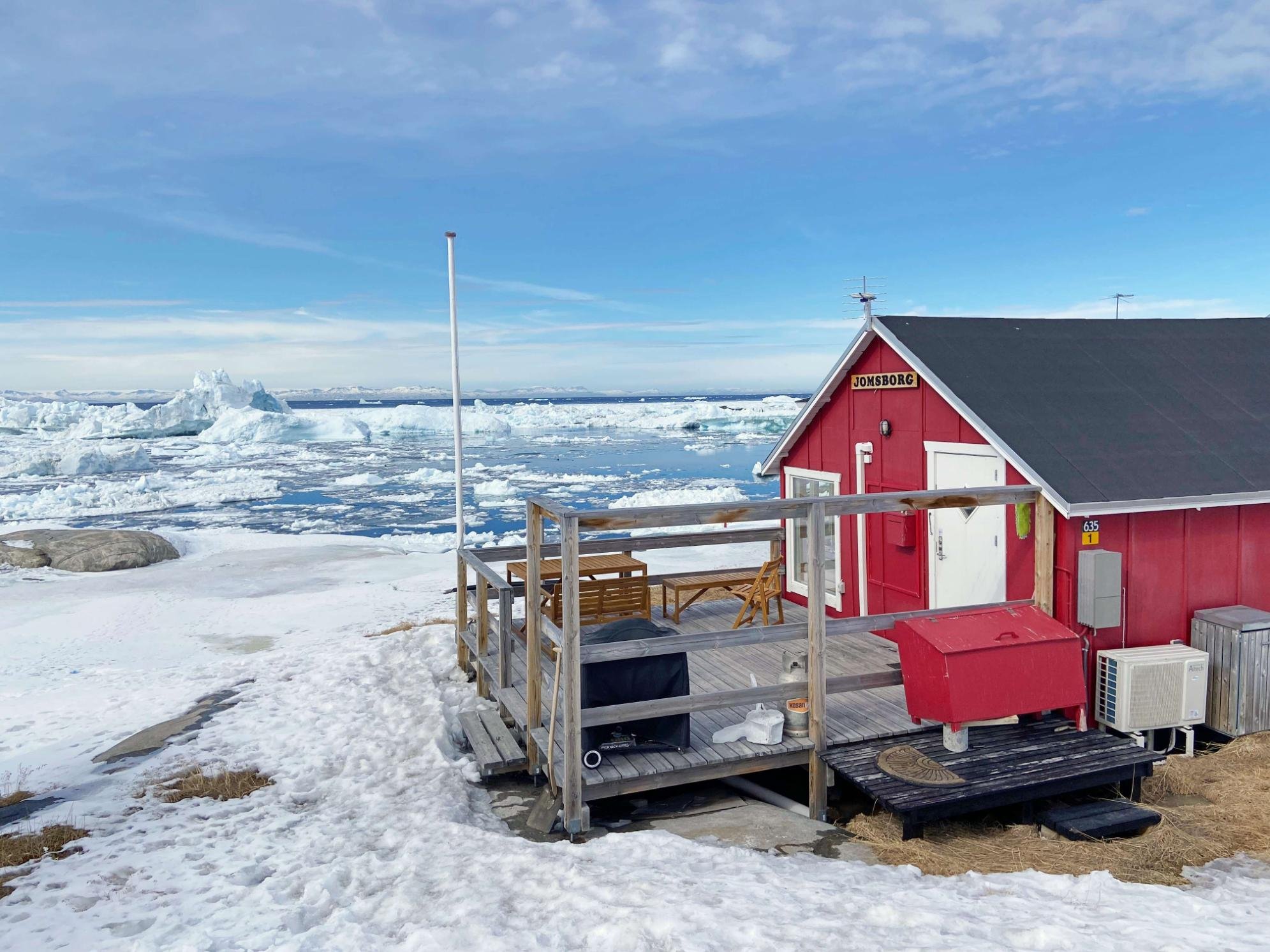
This was our cabin in Ilulissat. Too bright for the northern lights late April, but that view!!!
Accommodation in Greenland is limited and books up months in advance during the aurora season — this is not a last-minute destination.
In Ilulissat, staying within walking distance of the icefjord rim puts you as close to the aurora foreground as accommodation gets anywhere in the world. We stayed in a cabin right by the ice! The town is small enough that almost any property gives you access to dark sky within a short walk. Our Nuuk vs Ilulissat guide covers the accommodation logic for both towns in detail, and you’ll find accommodations with a view in our guide to the best hotels + cabins in Ilulissat.
In Nuuk, the priority is proximity to the fjord rather than the town center — properties closer to the water's edge give you darker skies and a stronger foreground. Our full Nuuk hotels guide covers the specific options with notes on location.
In Kangerlussuaq, accommodation options are limited to a small number of guesthouses and airport hotels — book as early as possible if you're building an extra night here specifically for the aurora. The upside is that you're already in the dark: step outside and you're in conditions that most aurora chasers would travel a long way to find.
Across all locations, north-facing windows are worth asking about when booking — being able to watch the sky from inside before committing to going out is a small but meaningful comfort at Arctic temperatures.
🗺️ Zoom in on the map below to find a cabin or hotel with aurora views in Greenland:
✈️ Find flights
🏨 Explore hotels, apartments, guesthouses, cabins
🧭 Browse activities and tours
🧳 Get travel gear (including our Arctic essentials)
🛡️ Travel safe with Heymondo Travel Insurance (5–15% off)
📱 Get a travel eSIM
🐾 Protect & track Arctic wildlife with Fahlo Bracelets (20% off)
FAQ: Northern lights in Greenland
Can you see the northern lights in Greenland?
Yes — Greenland is one of the best places on earth to see the northern lights. Most of the country sits inside the auroral oval, meaning lower KP levels are sufficient for visible aurora than at destinations further south. Ilulissat at 69°N can see aurora at KP 1 to 2 on a clear night. The main obstacle, as everywhere, is cloud cover rather than geomagnetic activity.
When is the best time to see the northern lights in Greenland?
The aurora season runs late August through mid-April. March is statistically the strongest month — a natural peak in geomagnetic activity around the spring equinox, combined with still-long nights and often clearer skies than deep winter. September and October offer a similar equinoctial boost with less extreme cold.
Where is the best place to see the northern lights in Greenland?
Ilulissat offers the most visually extraordinary conditions — aurora over the UNESCO Ilulissat Icefjord is a combination that exists nowhere else on earth. Kangerlussuaq is the best location for sheer sky clarity, with more clear nights than almost anywhere else in the Arctic. Nuuk is the most accessible base and delivers strong aurora conditions with a short drive from the city.
What is the best time to see the northern lights in Nuuk?
September through March, with February and March offering the best balance of darkness, clear skies, and strong geomagnetic activity. Nuuk sits at 64°N, inside the auroral oval, so KP 2 to 3 is sufficient for a visible display on a clear night. Drive fifteen minutes from the city center for genuinely dark skies.
What is the best time to see the northern lights in Ilulissat?
October through March. Ilulissat at 69°N sees aurora at lower activity levels than Nuuk, and the icefjord foreground is at its most dramatic in winter when the fjord surface is frozen. March combines strong geomagnetic conditions with still-long nights and the beginning of improving weather.
How many nights should I book to see the northern lights in Greenland?
Five nights minimum for a realistic chance. Cloud cover is the most common reason people miss the aurora even during active periods, and it can persist for several consecutive nights. Seven nights significantly improves your odds, particularly in coastal towns where weather is less predictable than inland locations like Kangerlussuaq.
We have a special playlist to call the northern lights. Give it a try!
Greenland is not the easiest aurora destination. It takes more planning, more budget, and more deliberate effort than a flight to Tromsø or Reykjavík. What it gives you in return is an aurora experience that is, at its best, completely unlike anything the more traveled destinations offer. Lights over icebergs. A sky with no competition from civilization for a hundred kilometers in any direction. The specific silence of an Arctic winter night interrupted by the crack of a calving glacier, and maybe a howling husky.
For everything else worth doing while you're here — the icefjord walks, the dog sledding, the ferry south — our Greenland Travel Guide covers everything. You can also browse all our Greenland guides by destination here.
Planning a Northern Lights Trip? ✨
Get a free aurora checklist straight to your inbox.
No spam. Just northern lights strategy (and occasional penguin energy).
Thank you, little penguin! 🐧
Check your inbox — our best Northern Lights tips are on the way.
